
Ladybugs that don’t Multiply
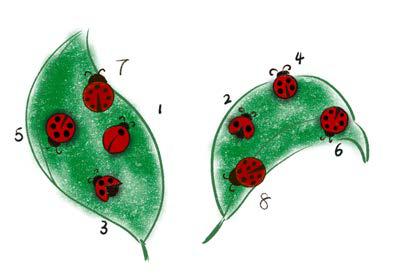
Numbered ladybugs are landing on two leaves. The rule is that no two ladybugs on a leaf can multiply to be the number of another ladybug on that leaf. The leaf on the left is fine, but the leaf on the right has 2 x 4 = 8.
THE CHALLENGE
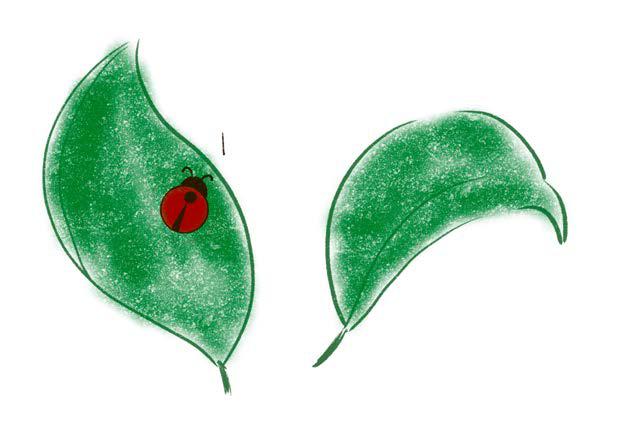
Starting at 1 and counting up, how high can you go putting the numbered ladybugs on either of the two leaves while following the rule for each of the leaves?
EXPLORATION
What are large sets of (not necessarily consecutive) numbers that are allowable to have on a single leaf? How much higher can you go with consecutive numbers if you use more than two leaves?
Notes
THE CHALLENGE & EXPLORATION
This puzzle provides an opportunity to look more closely at primes and prime factorizations.
One leaf can have all numbers that are units (1), primes, and squares of primes. That’s a very big chunk of numbers. The other leaf gets all the rest of the numbers. Doing that gets all the numbers up to 47, and it’s hard to see how to improve on that. Here are the numbers for the two leaves:
(1, 2, 3, 4, 5, 7, 9, 11, 13, 17, 19, 23, 25, 29, 31, 37, 41, 43, 47} and {6, 8, 10, 12, 14, 15, 16, 18, 20, 21, 22, 24, 26, 27, 28, 30, 32, 33, 34, 35, 36, 38, 39, 40, 42, 44, 45, 46}
What the best strategy to use for three leaves is far from clear. One simple approach is to take numbers that are products on the second leaf and put them on a third leaf – numbers such as 48, 60, 72, 80, and 84. The second leaf would hold all things of the form p3, p4, p5, p6, p × q, p2 × q, p3 × q, p2 × q2, p × q × r, where p, q, and r are primes – that’s a large and safe collection. This process would get you all the way up to the number 48 × 60 – 1, so that’s a very large range to work with.
Another approach would be to break apart the second leaf’s numbers into two groups, but it’s not clear how best to do that.