
Fractions – 4
THE CHALLENGE
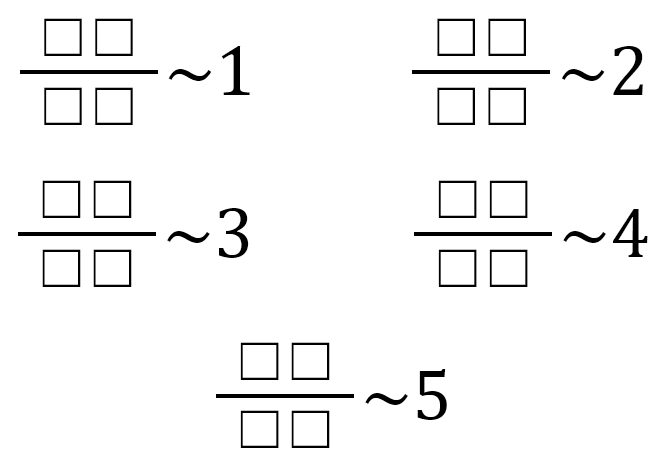
Use the numbers 1 to 9 at most once each to fill the boxes in each of these puzzles. Make these two-digit fractions as close to the target numbers from 1 to 5 as possible, without equalling the number. For example, 85/ 17 = 5 is not allowed as a contender, but 83 / 17 is okay and is somewhat close to 5.

EXPLORATION
Look at what happens for targets from 6 to 10. What changes in your strategy for targets above some value?
Notes
THE CHALLENGE & EXPLORATION
The target number of 1 is a different case from the other targets.
To get close to 1, we need the numerator and denominator to be as close as possible. Because they have different tens digits, and we cannot use 0’s, the closest we can get is two apart – for example, 29 and 31 yields 29/31 or 31/29. The distance away from 1 will be 2 over the denominator. Keeping with the example, the differences with 1 are 2/31 and 2/29.
With 2 as a constant numerator, we want to make the denominator as large as possible to get close to 1. 91/89
does not work as it uses 9 twice. 81/79 is therefore the best answer.
It is simpler for the target numbers larger than 1. Take 6 as an example target. 96/16 = 6 exactly. To get close to that we have a choice of 97/16 or 95/16, which are equally close, both being 1/16 away.
The answers are:
- 1 81/79
- 2 95/48 or 97/48
- 3 95/32 or 97/32
- 4 95/24 or 97/24
- 5 91/18
- 6 95/16 or 97/16
- 7 97/14
- 8 95/12 or 97/12
Above a target of 8, the best we can do is 98/12 no matter what the target number is. 98 cannot be made any larger, and 12 cannot be made any smaller.