
Fractions – 5
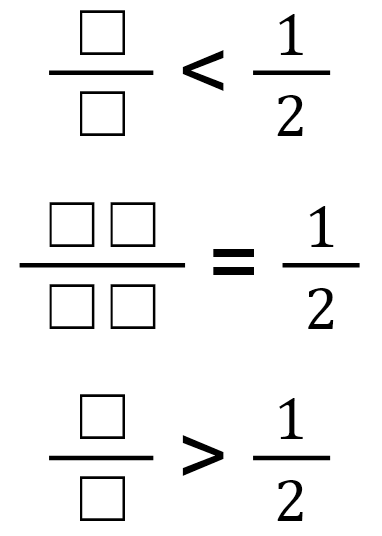
Example: 2/5 is less than 1/2, 19/38 equals 1/2, and 4/7 is larger than 1/2. The difference between 4/7 and 2/5 is (4/7 – 1/2) + (1/2 – 2/5) = 1/14 + 1/10, which is not particularly small. The fractions 2/5, 19/38, and 4/7 use the digits 1 to 9 at most once each.
THE CHALLENGE
Use the numbers 1 to 9 at most once each to fill in these boxes. Make the difference between the largest and smallest fraction as small as possible.

Notes
THE CHALLENGE
After some initial exploring, it is clear that 1/14 + 1/18 is the best possible difference. That difference comes from using denominators of 7 and 9, and there are no better ones. The only ways to get that difference are: 5/9 – 3/7 or 4/7 – 4/9, and the second one is not allowed because four is repeated.
If 3, 5, 7, and 9 are used on the outside fractions, that only leaves 1, 2, 4, 6, and 8 to be used for the middle fraction. There are only two ways to get 1/2 using those numbers without repeating a digit: 14/28 and 41/82.
This leaves two entries tied for first place:
3/7 < 14/28 = 1/2 < 5/9
3/7 < 41/82 = 1/2 < 5/9