
Ladybugs that don’t Add Up – 2
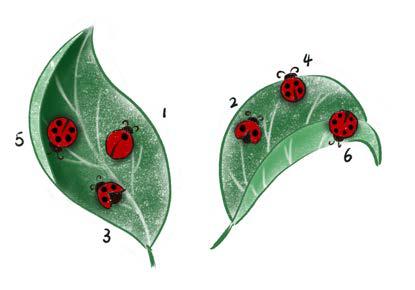
Numbered ladybugs are landing on two leaves. The rule is: the number of dots of two ladybugs on a leaf cannot add up to the number of dots on another ladybug on that leaf. The leaf on the left is fine, but the leaf on the right has 2 + 4 = 6.
THE CHALLENGE
Starting at 1 and counting up, how high can you go putting the numbered ladybugs on three leaves while following the rule for each of the leaves?
EXPLORATION
How do things change if you use only even numbers? How do things change if you use only odd numbers? What happens if you use more than three leaves?
Notes
THE CHALLENGE & EXPLORATION
Three leaves is a lot trickier to deal with in an organized way than two leaves.
While there is much that is complex about this problem, there are two simple ways to put numbers in a leaf that are surprisingly powerful: 1) put the powers of 2 on the leaf (1 2 4 8 16 …) and 2) starting with some number, put all the consecutive numbers up through twice that number (5 6 7 8 9 10).
We can also take the best answer for two leaves, (1 2 4 8) – (3 5 6 7), and then put the next numbers on the third leaf: (1 2 4 8) – (3 5 6 7) – (9 10 11 12 13 14 15 16 17 18). After that good start, we can put a few more numbers on the first two leaves: (1 2 4 8 22) – (3 5 6 7 19 20 21) – (9 10 11 12 13 14 15 16 17 18).
That answer, that goes up to 22, is surprisingly close to the best answer. To know for sure what the best possible answer is, you either need to write a computer program or you can consult the math literature on “sum-free sets” or “sum-free partitions.” In the literature you will find the following answer to 23, which has only a couple changes (moving the 11 and 16)from the earlier answer: (1 2 4 8 11 16 22) (3 5 6 7 19 21 23) (9 10 12 13 14 15 17 18 20).
The best answer for four leaves goes up to 66 and is: (1 2 4 8 11 16 22 25 40 43 53 66) (3 5 6 7 19 21 23 34 35 50 51 52 63 64 65) (9 10 12 13 14 15 17 18 20 54 55 56 57 58 59 60 61 62) (24 26 27 28 29 30 31 32 33 36 37 38 39 41 42 44 45 46 47 48 49). You can get surprisingly close to this answer by employing the same strategy as we used for getting a first answer for three leaves.
The best answer for five leaves goes up to 196. It is an unsolved problem what the best answer is for six leaves! Perhaps one of your students will have fun playing with this and coming up with a great answer!
Working with even numbers is simply a matter of doubling everything from before. The best answer for even numbers will be twice the best answer for regular numbers.
The odd numbers can all be put on one leaf, so having three leaves doesn’t make much difference for them.