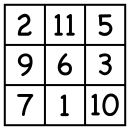
Magic Square – 5
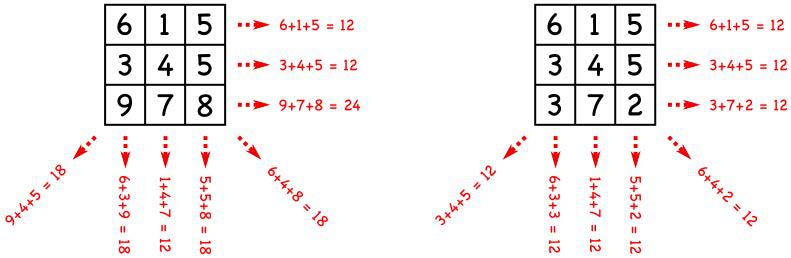
In a Magic Square, all the rows, columns and diagonals add up to the same number. This first square is not a Magic Square. The second one is a Magic Square with a constant sum of 12.
THE CHALLENGE
We have seen how to make a Magic Square with a set of numbers that are evenly spaced, such as {2, 6, 10, 14, 18, 22, 26, 30, 34}. Can you make a Magic Square that has no duplicate entries, where the numbers are not all evenly spaced?
EXPLORATION
Which shortcuts have you found for creating 3 by 3 Magic Squares? Can you devise a general method for constructing any Magic Square that has no duplicate entries?
Notes
THE CHALLENGE & EXPLORATION
As we have talked about in the earlier Magic Square puzzles, the central square must be the average of all nine numbers. Call that number “c.” The common sum will be 3c.
In the 1800’s, Ėdouard Lucas found a formula for generating all 3 by 3 Magic Squares that do not have repeated entries. If you pick two positive numbers a and b so that a < b < (c – a) and b is not 2a, then you have this Magic Square.
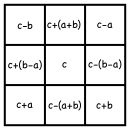
These numbers are, in increasing order: c – (a + b), c – b, c – (b – a), c – a, c, c + a, c + (b – a), c + b, c + (a + b).
For example, to get the numbers from 1 to 9, let c = 5, a = 1, and b = 3.
It’s interesting that the numbers larger than c exactly correspond to the numbers less than c.
Armed with these formulas, simply pick a and b so that b – a is not 2a. For example, let a = 1 and b = 4. Let c = 6 to keep things from getting negative. With those values the numbers are: 1, 2, 3, 5, 6, 7, 9, 10, 11, and they produce this square with common sum 18.