
Magic Squares – 4
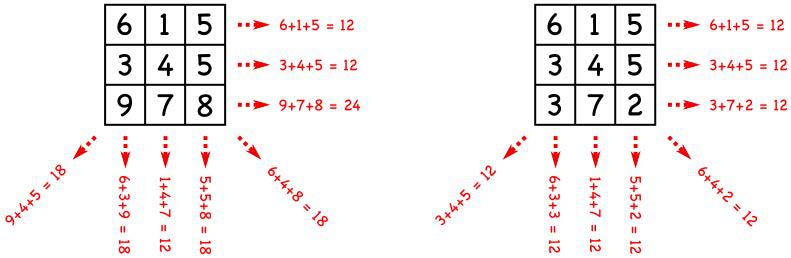
In a Magic Square, all the rows, columns and diagonals add up to the same number. This first square is not a Magic Square. The second one is a Magic Square with a constant sum of 12.
THE CHALLENGE
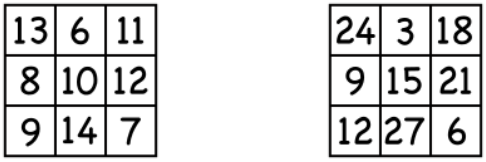
Fill in these two Magic Squares using these two sets of numbers: 1) {6, 7, 8, 9, 10, 11, 12, 13, 14} and {3, 6, 9, 12, 15, 18, 21, 24, 27}.
EXPLORATION
Look at all the Magic Squares you’ve seen that don’t have duplicate entries. Make a table of your results and look for patterns. If you were given any other sequence of numbers that are evenly spaced, such as {4, 9, 14, 19, 24, 29, 34, 39, 44}, would you be able to immediately fill in the Magic Square?
Notes
THE CHALLENGE & EXPLORATION
Start with the solution to the standard 1 – 9 version of this puzzle.
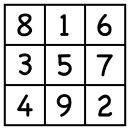
To make a Magic Square with 6 to 14, simply add 5 to all of those entries. To make a Magic Square for {3, 6, 9, 12, 15, 18, 21, 24, 27}, simply triple all the entries of the original solution.
Let’s see why that works. Suppose we have a + b + c = S, where S is the sum used for all rows, columns, and diagonals. In the original 1 – 9 puzzle, S was 15.
If we add 5 to all the entries, (a + 5) + (b + 5) + (c + 5) = (a + b + c) + 15 = S + 15. The entries in the new puzzle all add up to a sum that is 15 more than the original, so they still all add up to the same (new) thing.
If we multiply by 3, then (3a) + (3b) + (3c) = 3(a + b + c) = 3S. The entries in the new puzzle add up to a sum that is three times the original.
If we do any combination of multiplying and adding, it still works. Suppose we multiply by m and then add n. We get (ma + n) + (mb + n) + (mc + n) = (ma + mb + mc) + (n + n + n) = m (a + b + c) + 3n = mS + 3n. So, no matter what m and n are, the new entries end up all adding up to the same thing!
Of course, your students are not ready for this algebra, but by going through these examples they will see the patterns of how this works