
Magic Triangles – 1
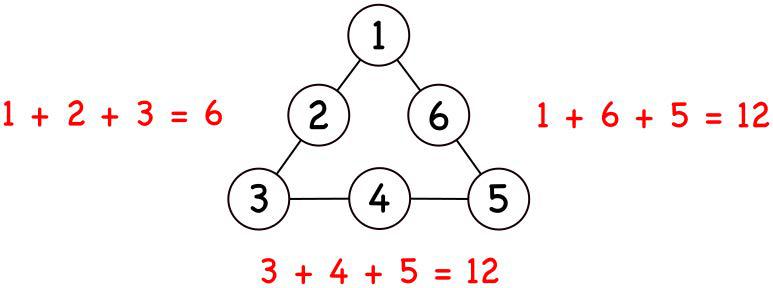
The sums of the sides of a Magic Triangle are all the same. This example is NOT a Magic Triangle.
THE CHALLENGE
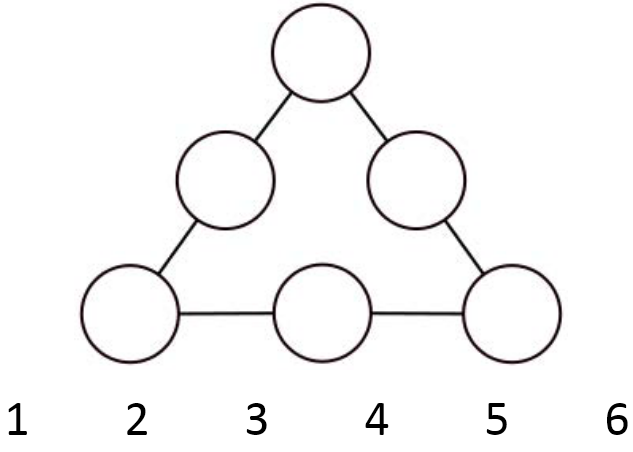
Use the numbers from 1 to 6 to make a Magic Triangle below.
EXPLORATION
What are the different sums that are possible for Magic Triangles that use 1 to 6?
Notes
THE CHALLENGE & EXPLORATION
Let your students play with this. If they pay attention to what they’re doing, they’ll discover interesting relationships and get a lot out of it. For young students, there is absolutely no need to go into any kind of careful analysis.
To be more analytical, add up the three sides. This sum will be the sum of the numbers from 1 to 6 plus the three corners an extra time. The sum of the numbers from 1 to 6 is 21. So, three times the common sum is 21 plus the sum of the three corners. Looked at another way, the common sum will be 7 plus one third of the sum of the corners. The smallest possible sum of three corner numbers is 1 + 2 + 3 = 6, and the largest is 4 + 5 + 6 = 15. So, the common sum might be anything from 7 + (6 / 3) = 9 to 7 + (15 / 3) = 12. Let’s look at them 1 at a time.
Common Sum = 9. The corners must be 1, 2, and 3. The number between 1 and 2 must be 6. The number between 1 and 3 must be 5. The number between 2 and 3 must be 4. It works!
Common Sum = 10. The corners add up to 9. The corners could be (1 3 6), (1 3 5), or (2 3 4). (1 2 6) cannot work because there is nothing that can be put between 1 and 2. (1 3 5) can work by putting 6 between 1 and 3, 4 between 1 and 5, and 2 between 3 and 5. (2 3 4) cannot work because there is nothing that can be put between 2 and 4.
Common Sum = 11. The corners add up to 12. The corners could be (1 5 6), (2 4 6), or (3 4 5). (1 5 6) cannot work because there is nothing to put between 5 and 6. (2 4 6) can work because you can put 1 between 4 and 6, 3 between 2 and 6, and 5 between 2 and 4. (3 4 5) cannot work because there is nothing to put between the 3 and 4.
Common Sum = 12. The corners must be 4, 5, and 6. The number between 4 and 5 must be 3. The number between 4 and 6 must be 2. The number between 5 and 6 must be 1. It works!
There are four solutions in total.
You can save a lot of work if you realize that you can get all the answers for the Common Sum being 11 and 12 by taking the answers for the Common Sum being 9 and 10 and subtracting those entries from 7. For example, the answer for Common Sum = 9 has sides (1 6 2), (1 5 3), and (2 4 3). If these entries are subtracted from 7, the answer for Common Sum = 12 is found, namely (6 1 5), (6 2 4), and (5 3 4).
If you compare “Equal Sums – 2” with “Magic Triangles – 1,” you will see that they are the same puzzle!