
Pan Balance With Weights – 1
A pan balance tells you when its two sides are carrying the same amount of weight or whether one side is heavier than the other.
THE CHALLENGE
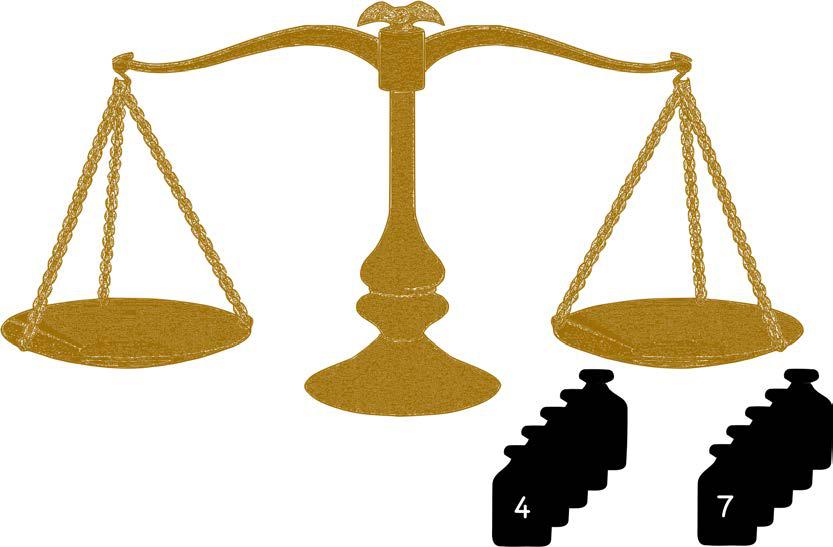
You have a very large collection of 4-ounce and 7-ounce weights to use on one side of a pan balance. By using two 4-ounce weights, you can measure an 8-ounce item. Which weights can you weigh exactly and which ones can’t you weigh exactly?
EXPLORATION
How do your results change if you have 5- and 9-ounce weights? How about other pairs of weights that have no common divisor larger than 1? Can you find any patterns in your data?
Notes
THE CHALLENGE
This is often called the Chicken McNugget Theorem.
Start by doing something not entirely obvious. Make a chart of the numbers with rows of length one of the two numbers you’re working with. We’ll make the rows 7 long, but it would work just as well to make them 4 long. Next, put all the sums of multiples of 4 and multiples of 7 in red, as shown below.
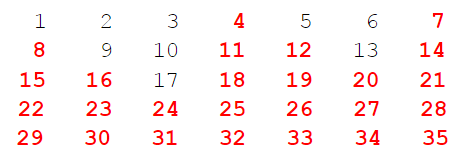
A few things jump out when you see the data this way. One is that, once a column has one hit, the rest of that column is filled. Another is that the multiples of 4 bounce around the columns without repetition until you hit 4 x 7. By 4 x 7, every column has been hit by a multiple of 4.
Starting at 18, all the numbers are hit. This is in line with the general theorem. The theorem says that if the two numbers are m and n and they are relatively prime, then all numbers will be hit starting with (m – 1) x (n – 1), which in our case is 6 x 3 = 18.
Another part of the theorem is that exactly half the numbers from 1 to (m – 1) x (n – 1) will be hit. In our case that is 9 numbers out of 18.
EXPLORATION
For 5 and 9, the point of saturation starts at (5 – 1) x (9 – 1) = 4 x 8 = 32, and 16 of the numbers up to 32 will be hit.