
Pan Balance With Weights – 4
A pan balance tells you when its two sides are carrying the same amount of weight or whether one side is heavier than the other.
THE CHALLENGE
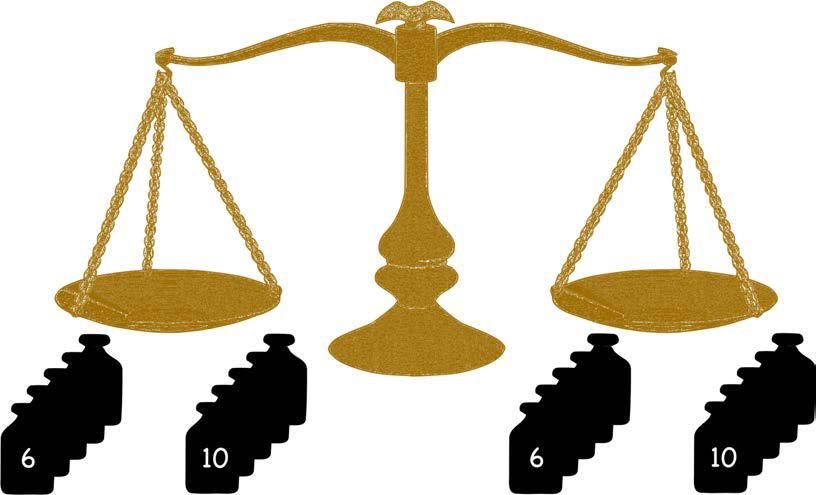
You have a very large collection of 6-ounce and 10-ounce weights to use on both sides of a pan balance. You can weigh a 4-ounce item by using a 6-ounce weight together with the item on one side and a 10-ounce weight on the other. Which weights can you weigh exactly and which ones can’t you weigh exactly?
EXPLORATION
How do your results change if you have 6- and 9-ounce weights? How about other pairs of weights that have a common divisor larger than 1? How do your results compare to the ones you got in “Pan Balance With Weights – 3”? Can you make use of that earlier work to save you reinventing things for this problem? What would happen if you had three kinds of weights to work with – say 3 ounces, 6 ounces, and 10 ounces?
Notes
THE CHALLENGE
We can employ the same idea we used in going from Pan Balance With Weights 1 to 2. Because the greatest common divisor of 6 and 10 is 2, everything will be a multiple of 2. So, Bezout’s Theorem (mentioned in Pan Balance With Weights – 3) tells us that we will be able to weigh all objects that have a weight that is a multiple of 2.
EXPLORATION
Because the greatest common divisor of 6 and 9 is 3, we will be able to weigh all multiples of 3 ounces with those two weights.
If there are three weights, start by analyzing what happens with a pair of them. We saw that the multiples of 6 and 10 give us all multiples of 2. Then we can then take all multiples of 2 and 3 (by combining 6 and 10) and see that we are able to get all multiples of 1 (all numbers).