Perfect Rectangles – 1
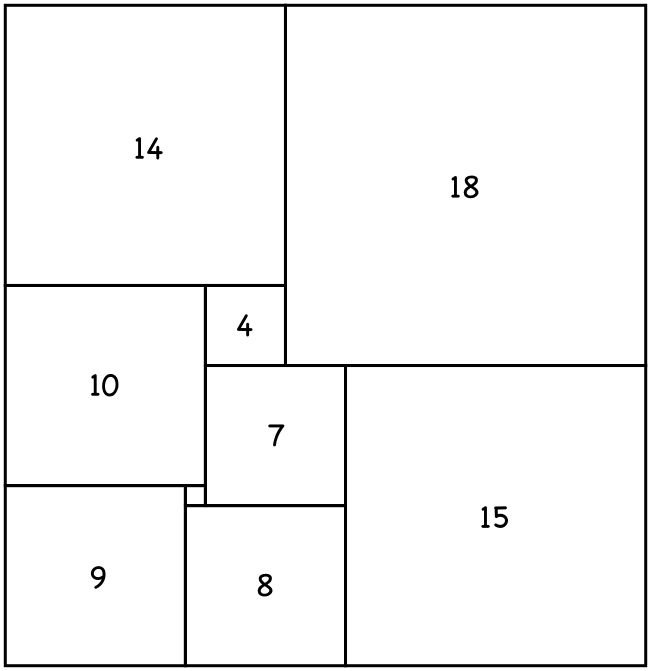
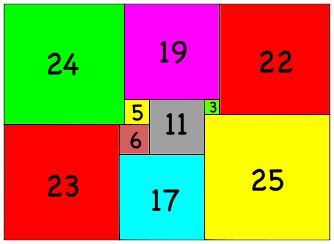
A rectangle that can be filled with squares, no two of which have the same size, is called a Perfect Rectangle. Here is an example of a 47 by 65 Perfect Rectangle filled with 10 squares of different sizes.
THE CHALLENGE
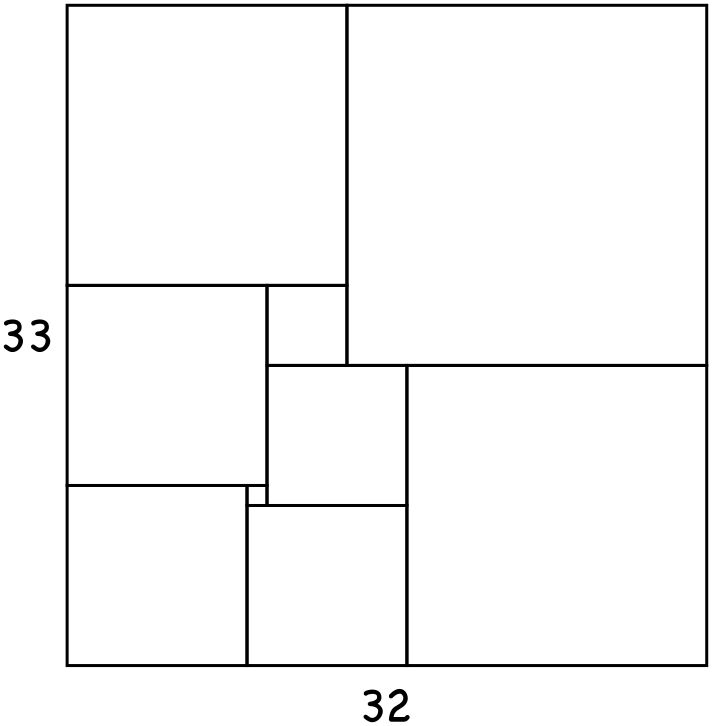
Find the sizes of the squares in this 33 by 32 Perfect Rectangle filled with 9 squares.
Notes
THE CHALLENGE
Your students can measure the diagram carefully to come up with the sizes, but hopefully they will enjoy the challenge of doing the problem solving instead.
A good place to start is with the six squares in the lower left corner.
Let n be the size of the smallest square, and x the size of the square in the Middle of the Bottom row (call it MB for short).
The squares that surround the smallest square increase in size by n as they go around the smallest square. The square on top of MB has size x – n, and the square in the bottom left corner has size x + n. Also the square in the bottom right corner has the combined sizes of MB and the square on top of MB, so its size is x + (x – n) = 2x – n. The sizes of the squares on the bottom “row” of this diagram add up to 32, so 32 = (x + n) + x + (2x – n) = 4x, which means x = 8.
The stack along the bottom left side is (x + n) + (x + 2n) = 2x + 3n high. The stack of three squares in the bottom middle is x + (x -n) + middle square = 2x – n + middle square. Because 2x + 3n = 2x – n + middle square, the middle square is 4n in size. If n is 2, we would have two squares of size 8. If n is 3 or bigger, that middle square would be too big. So, n = 1.
With x = 8 and n = 1, and knowing the size of the rectangle as 33 by 32, filling in the rest of the squares is automatic.