
Sum Pyramids – 2
These pyramids are called Sum Pyramids. The number above each pair of connected numbers is their sum.
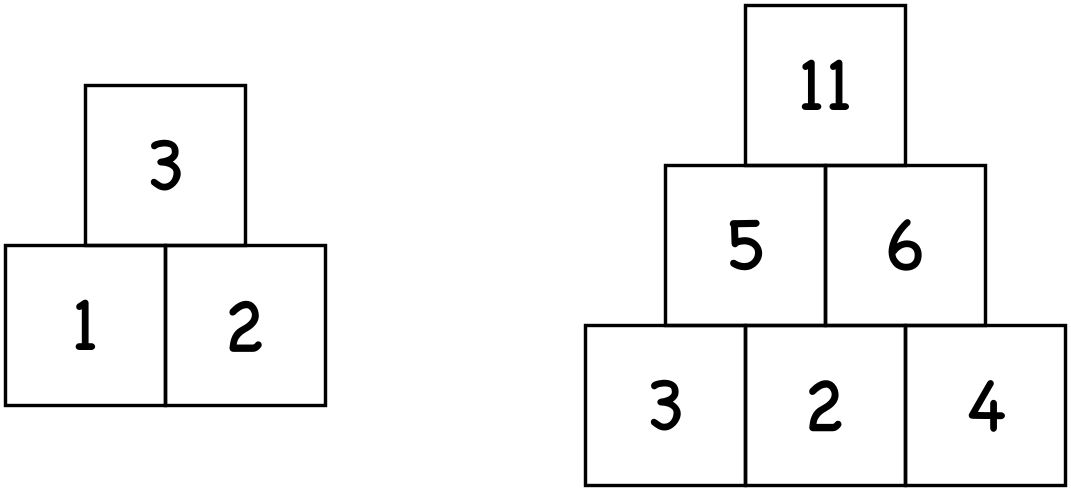
THE CHALLENGE
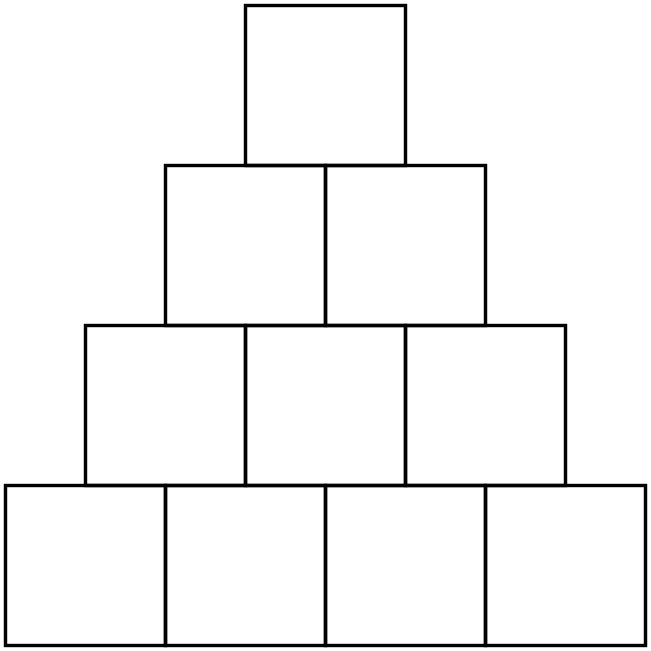
Place some of the numbers from 1 to 25, not repeating any number, to make a Sum Pyramid with the smallest possible number on top. Can you do better than 25?
Notes
THE CHALLENGE
The pyramid is completely determined by the entries in the bottom row.
Each of the middle numbers in the bottom row will contribute a total of three times to the number on the top of the pyramid. The corner numbers in the bottom row will each only contribute once to the number on the top of the pyramid. Therefore, let’s use 1 and 2 for those middle numbers on the bottom row.
1 and 2 creates a 3 on the next row, so we can’t use it in the bottom row. Exploring how to finish out the bottom row we should consider (4 1 2 5), (5 1 2 4), (4 1 2 6), and (6 1 2 4). All of these produce duplicates. Looking further, we can try (5 1 2 7) or (6 1 2 8). However, (5 1 2 7) produces a duplicate entry, and (6 1 2 8) has a top number of 23, which is only a little better than 25.
Going back, let’s consider using 1 and 3 in the middle of the bottom row. Some exploration produces the following, which is our best answer.
(20)
(11 9)
(7 4 5)
(6 1 3 2)