
Trapezoidal Numbers – 5
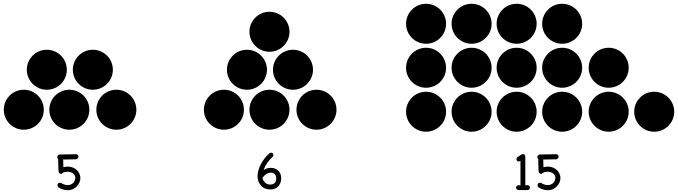
Trapezoidal Numbers are the sum of two or more consecutive numbers. They deserve their name because you can make a trapezoid with that many dots, as pictured in the examples below. Note that having 1 dot on the top row is stretching the idea of being a trapezoid a bit, but it is allowed for these numbers.
THE CHALLENGE
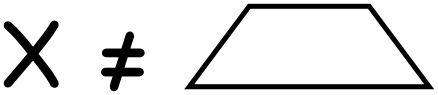
Find one number between 100 and 200 that is not a Trapezoidal Number.
EXPLORATION
Trapezoidal Numbers are one example of what are called Figurate Numbers. A Figurate
Number is a number that when that many dots are put in a special pattern, they make an interesting figure or
shape. Triangular Numbers and Square Numbers are two other examples of Figurate Numbers. Can you think of
other shapes of groups of dots that would deserve being called a Figurate Number?
Notes
THE CHALLENGE
In the Notes of “Trapezoidal Numbers – 4” we looked at all the ways to write the numbers from 1 to 20 as sums of consecutive numbers. After looking at that data, we made the following conjecture
Conjecture: The number of ways to write a number as a sum of consecutive numbers is equal to the number of odd divisors larger than 1 of the number.
Let’s look at why this conjecture is true. Suppose the number we are investigating is n, and that a = 2m + 1 is a divisor of n, so that a x b = n for some number b. There are two distinct ways of using this information to create a set of consecutive numbers that sum to n. One when
The number 18, with its two odd divisors 3 and 9, is useful in demonstrating the two ways of forming a set of consecutive numbers that sum to a number.
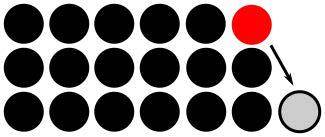
For 18’s odd divisor 3: 3 x 6 = 18. Start by creating three rows of six dots. As shown in the illustration, leave the middle row intact, and remove a triangle of (red) dots from the upper rows (in this case, just one dot) and move that triangle to the ends of the lower rows. 18 = 5 + 6 + 7.
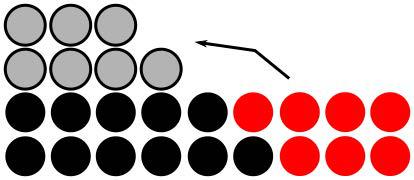
For 18’s odd divisor 9: 9 x 2 = 18. Start by creating nine columns of two dots. As shown in the illustration, leaving the middle column intact, take a trapezoid of (red) dots from the right side and rotate it to be on top of the columns to the left of the middle column. 18 = 3 + 4 + 5 + 6.
The only numbers with no odd divisors are powers of 2. Because they have no odd divisors, the powers of 2 are the only numbers that are not Trapezoidal Numbers.
So, the answer to this Challenge is to find a power of 2 that is between 100 and 200. The only such number is 128, which is 2 to the seventh power.
EXPLORATION
Rather than repeat the material, please look up Figurate Numbers and Polygonal Numbers on the internet. Wikipedia has good introductory articles on both of them.