Treasure Map – 2
When moving from a square in a treasure map, you must move exactly the given number of squares, and you can only move to the right, left, up, or down.
Here is one way to solve this example of a treasure map.

THE CHALLENGE
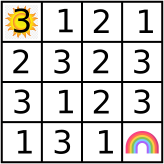
Find a route for the sun in the upper lefthand corner to move to get to the rainbow in the lower righthand corner of this treasure map.
EXPLORATION
Suppose we replace the rainbow with the number 2. How many different squares can the sun visit? Are there any squares that can’t be visited?
Make up a name for squares that don’t lead anywhere, perhaps “Dead End.” How many Dead Ends are there? A Ping-Pong Pair (PPP) is a pair of squares that go back and forth between themselves and cannot lead to anywhere else. It is a more complicated form of Dead End. Does this puzzle have any PPPs? Can you think of and name other interesting small groups of squares?
Notes
THE CHALLENGE
These puzzles are fun for children to play around with. They can be particularly fun if you make a big map on the ground (perhaps chalk or painter’s tape) that they can walk through as they try to discover the secret route to the treasure.
Beyond playing around and practicing with small numbers, these can give excellent practice with an important problem-solving technique. Namely, working forwards from the beginning and backwards from the end. These puzzles are simple enough that this technique is not essential, but it becomes extremely valuable for larger puzzles that are 5 by 5, 6 by 6, or larger.
Label the columns, from left to right, A, B, C, and D. Label the rows, from top to bottom, 1, 2, 3, and 4. The player starts at square A1 and wants to end up at D4.
Moving forwards from A1, the first move will either be to A4 or D1. A4 can go to A3 or B4. A3 bounces back and forth with D3, so it leads nowhere. B4 goes to B1. D1 can either go to C1 or D2. So, we want to connect up with either B1, C1, or D2.
Moving backwards from D4, there is only one way to get to D4 and that is from C4. The only way to get to C4 is from C2. The only way to get to C2 is from A2. And the only way to get to A2 is from D2. At last we have a connection! Notice that, for this puzzle, working backwards was much easier because there weren’t any choices so there were fewer possibilities to consider.
The answer is: A1 => D1 => D2 => A2 => C2 => C4 => D4.