
Playdate 48: Primes, Composites, and Powers
Playdate focus
Using multiplication, primes are the building blocks of numbers. Help your child develop a strong sense of prime factorizations. The new words for this Playdate are: prime, composite, unit, and power.
Activities properties
These involve lots of practice with multiplication and divisibility playing with Turning the Tables. Practice prime factorizations by using them when you play Beep.


Primes
Primes are central to understanding multiplication and division of whole numbers. As you will see, primes are the building blocks of numbers using multiplication. A prime number is a number larger than 1 whose only divisors are 1 and itself. The numbers 2, 3, 5, 7, and 11 are the first few prime numbers.
Composites and 1
There are three kinds of positive whole numbers: 1 (which is called a unit), primes, and composites. Composites can be thought of as being constructed from primes. For example, 12 is 2 times 2 times 3. Every number larger than 1 is either a prime or can be uniquely written as a product of two or more primes.
Prime factorizations
Getting to know prime factorizations really well will be very helpful for many parts of the math your child is about to learn. Repeating the prime factorizations of the numbers up to 20, or even 30, is a good exercize for getting to know these factorizations. Simply go through the list of numbers in order like this: 1 – unit, 2 – prime, 3 – prime, 4 – 2 times 2, 5 – prime, 6 – 2 times 3, 7 – prime, 8 – 2 times 2 times 2, 9 – 3 times 3, and 10 – 2 times 5.
Powers
Prime factorizations often involve repeated prime factors, so this is a good time to learn about powers and to practice them. It is quicker and easier to understand to say “2 to the fourth” than it is to say “2 times 2 times 2 times 2.” 2 squared means 2 times 2, and 2 cubed means 2 times 2 times 2.
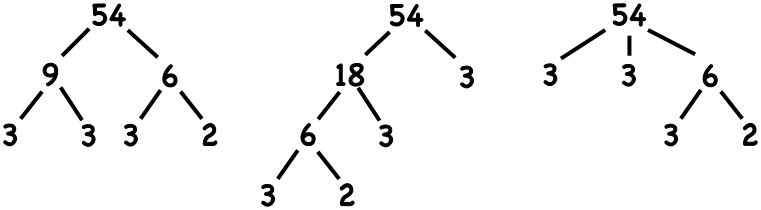
Factors and factor trees
For larger numbers, it may not be immediately obvious what the prime factorization is. For these numbers, find one of the factors and use that to break apart the problem into easier pieces. For example, 54 is 9 times 6. Because 9 is 3 squared and 6 is 2 times 3, we can put those together to have 54 is 2 times 3 cubed. This process is sometimes called making a factor tree, and pictured above are three possible ways for creating a factor tree for 54.