
Dominoes on a Chessboard
Question: Suppose 2 squares are removed from opposite corners of a chessboard. Can the resulting board be exactly covered by dominoes?
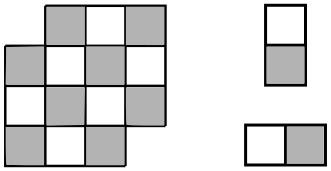
Mull, Distill, Represent
What is going on in the question? People like to rush into puzzles before really understanding what is being asked.
The representation for this puzzle is natural enough.
Is it important that the removed squares are in opposite corners? Is it important that it’s a chessboard, or is that a misdirection? What, if anything, is the connection between dominoes and chessboards?
Discuss these questions and anything else that your students come up with.
Play with it!
Smaller Examples: An important problem solving technique is to try smaller examples or smaller versions of the puzzle.
You might also try removing other pairs of corners and see what happens.
The 2 by 2 example is a little too small to get anything useful out of. Encourage your students to come up with the idea (on their own) of looking at 3 by 3 and 4 by 4 boards. What can they learn from those?
Results Any odd size, such as 3 by 3 or 5 by 5 is going to be impossible because there will be an odd number of squares. After some playing around, your students will probably conclude that the 4 by 4, 6 by 6, and 8 by 8 are impossible – but why?
Key Insight
This is a tricky puzzle because once you realize that the alternating colors of a chessboard are important, the problem becomes much easier to understand. After lots of play, and maybe coming back the next day, nudge your students to look at the light and dark squares.
Count up how many light and dark squares there are on a 4 by 4 board. After a domino is placed, how many of each color are left? After a second domino is placed, how many are left. Eventually they’ll see that, after all the dominoes are placed, they will be left with two of one color and zero of the other, so the puzzle is impossible.
Review
This is an interesting puzzle to review.
- At what point did each student realize why it works?
- Did they get there by different paths, or were they all the same?
- Is there a general method that they can learn from this puzzle that they can apply to other puzzles?
Explorations
Develop the habit in your students of wanting to explore where a puzzle may take them.
They’ve seen that it’s important that whatever squares are removed, you must be left with the same number of squares of each color.
- What happens if we remove two corners on the same side?
- What happens if we remove any two squares with different colors?
- Does it matter if the board is square or not?
- Does it always work as long as there are an even number of squares?
What happens if we try covering with other shapes? You could look at covering with L-shaped pieces that have a total of 3 squares in them. If you remove one corner from a chessboard, can it be covered by L’s?