
Perfect Rectangles – 2
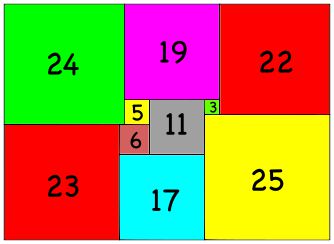
A rectangle that can be filled with squares, no two of which have the same side length, is called a Perfect Rectangle. Here is an example of a 47 by 65 Perfect Rectangle filled with 10 squares of different side lengths.
THE CHALLENGE
Find the side lengths of the squares in this 61 by 69 Perfect Rectangle filled with 9 squares.

Notes
THE CHALLENGE
One of the easier places to start is to look at the four large squares in the four corners.
The side length of the upper left plus the upper right is 69, while the upper left plus the lower left is 61, so that means the lower left is 8 less than the upper right. Similarly, the side length of the upper right plus upper left is 69, while the upper right plus the lower right is 61, so that means the lower right is 8 less than the upper left. Putting that together, the sum of the two upper squares is 16 more than the sum of the two bottom corners. Therefore, the square in the middle of the bottom must have side length 16.
The two squares on top of the square with side length 16 have side lengths that add up to 16 and a difference that is the side length of the central small square. Therefore, the central square has side length 2, 4, or 6. However, 4 and 6 are visibly too large, so the central squares side length is 2, and the two squares on top of the 16 square are 7 and 9.
Chasing this information around the diagram will now reveal the remaining side lengths.
