
Stars and Loops Inside Circles
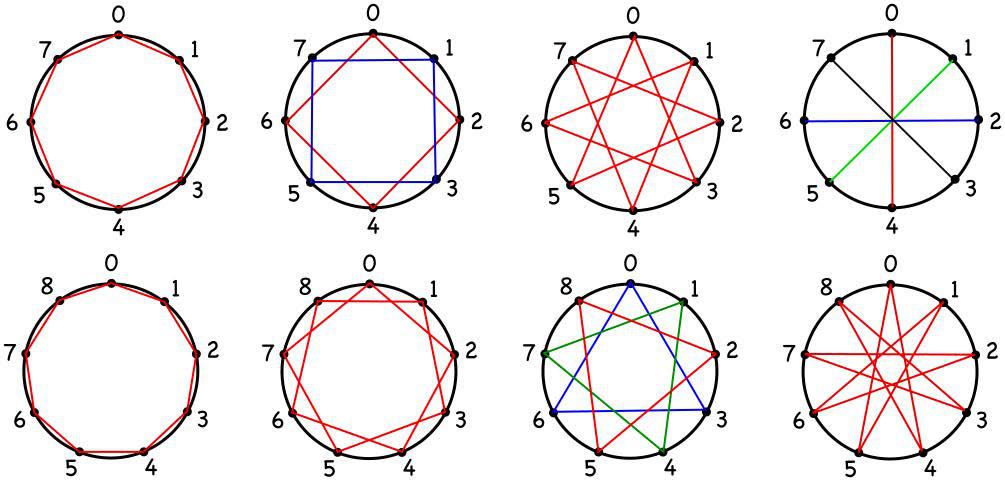
Place some pins evenly spaced around a circle. Picture below are circles with 8 and 9 pins. Make a star by setting a skip amount and attaching one color of string from pin to pin using that skip amount. For example, the third picture of the first row skips by 3 each time, and connects 0 – 3 – 6 – 1 – 4 – 7 – 2 – 5 – 0. In that example, one loop of string connects all the numbers. In other examples, several loops of string were needed to involve all the numbers.
THE CHALLENGE
Suppose you have 12 pins evenly spaced around a circle. For each skip amount, find how many loops of string you will need and how many numbers will be in each loop of string. What do you notice about the loop lengths?
EXPLORATION
Investigate what happens for other numbers of pins. Can you predict what will happen with the loop lengths and number of loops for a given number of pins and skip amount?
Notes
THE CHALLENGE
For 12 pins, the following occurs for the different skip amounts:
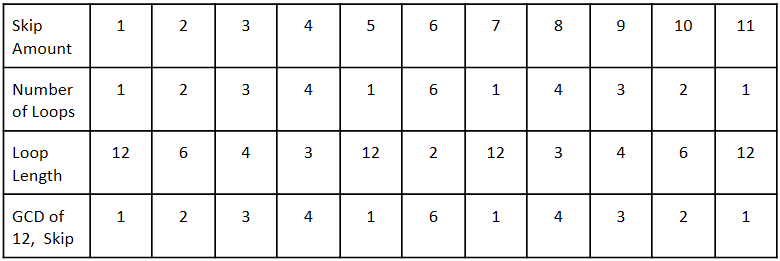
Before looking at the table, it is worth noticing that the loop length is the same for all the loops for a given skip amount.
A few things stand out from this table. Perhaps the easiest is that the number of loops times the loop length is always the number of pins. Another is that it is symmetric about the “6” column.
If you look at the GCD (or GCF) of the number of pins (12) and the skip amount, you’ll notice that it’s always the same as the number of loops!
EXPLORATION
The observations from The Challenge should be pursued.
- For a given skip amount and pin count, why are all the loops the same length? Begin with the loop that starts at 0 and ends at 0. Every number in the loop that starts at 1 will be 1 more than the ones in the loop that starts at 0, and so the loop that starts at 1 will have the same length. The same logic holds for any starting point.
- For a given skip amount and pin count, why is the product of the number of loops and the loop length equal to the number of pins? The loops cannot overlap and they include all the numbers, so this result follows easily.
- Why is the GCD of the skip amount and the pin count equal to the number of loops? First notice that all the numbers in the loop that starts at 0 are exactly the multiples of the GCD. After that, the discussion of point (1) makes it clear that there will be that many loops before the loops start repeating their content.
- Why is the table symmetric about the middle column? This symmetry is due to the GCD being symmetric. GCD(n, k) = GCD(n, n – k), where n is the number of pins and k is the skip amount.