Connect the Dots
How to create
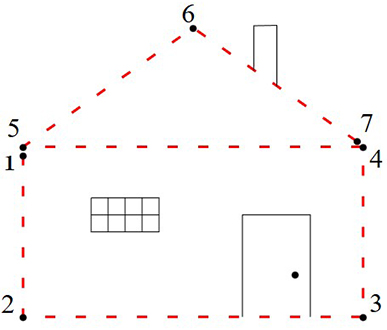
Complete fun drawings by connecting numbered dots. Make these by taking a simple drawing, removing some straight lines, and replacing them with numbered dots. Connecting the dots in order recreates the original drawing.
Backwards
Challenge your child to connect the dots in backwards order.
You can also find these kinds of drawings to download from the internet.
Bonus Material
Making Everyday Scenes With Dots
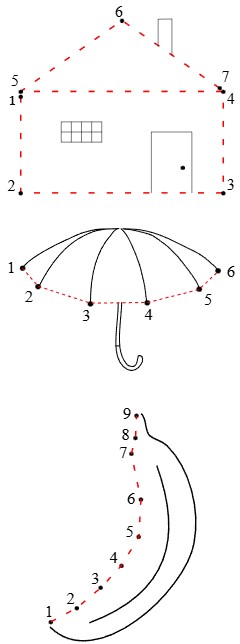
Complete fun drawings by connecting numbered dots. One way is to take a simple drawing, say of a house, remove some straight lines and replace them with numbered dots, that when connected in order recreate the original drawing.
Making Geometric Patterns With Angles
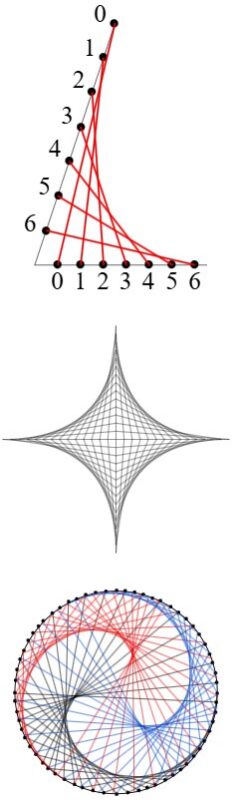
Make abstract drawings by connecting points with the same number along opposite sides of an angle. The numbers may not be needed – if so, feel free to omit them – this will make the finished designs a little less cluttered. You can add variety to these by having your child draw with colors. There are lots of amazing examples of this to be found under the category of String Art on the Internet. This circle drawing was made by moving ahead by one dot on one side of the line segment and ahead by two dots on the other side.
Making Patterns With Circles
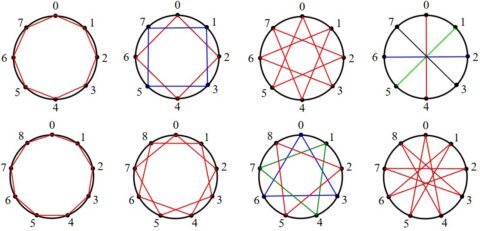
This is a special case of the last idea. Put some dots, say 8 or 9, evenly spaced on a circle. Your child can play with creating different patterns by connecting the dots in order, or connecting every second dot, or every third dot. To make it easier to do different experiments, use push pins in a piece of cardboard or wood and then use string between the push pins.
If your child is intrigued by the patterns that are produced, you can look at questions such as: For a circle with 8 dots, why is only one string needed to skip by 1, 3, 5, or 7, but 2 or 4 strings are needed for skipping 2, 4, or 6. Similarly, for a circle with 9 dots, why is only one string needed to skip by 1, 2, 4, 5, 7, or 8, but 3 strings are needed for 3 and 6? It’s too young to understand the idea that 2, 4, and 6 have a factor in common with 8, and 3 and 6 have a factor in common in 9 – however, seeing the patterns may plant the seeds for later ideas.