Number Sudoku
The setup
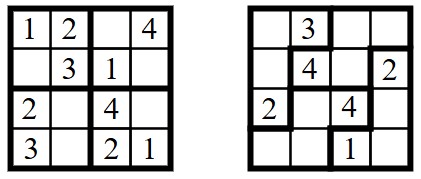
These are similar to the Shape Sudokus, only now they use numbers (or quantities of dots). To avoid erasing, use numbered (or dotted) slips of paper to solve the puzzles.
For a 4 by 4 puzzle, each row and column has the numbers from 1 to 4 once. Also, each marked subregion has the numbers from 1 to 4 once. That’s it! Create these puzzles for your child by starting with a completed puzzle and removing some of the pieces of paper.
Variations
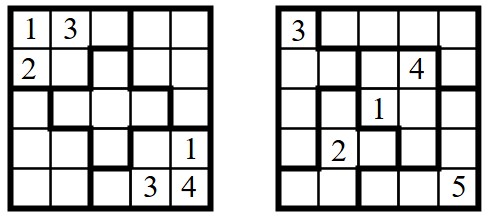
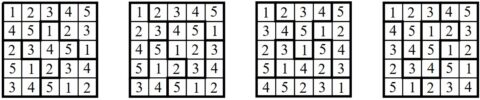
For variety, use irregularly-sized subregions – these are called Jigsaw Sudoku puzzles. You can also create puzzles of larger size (two 5 by 5 puzzles are shown).
Bonus Material
Introduction
This is similar to the Shape Sudoku puzzles, only now it uses numbers. If your child is not ready to recognize numerals yet, you can use quantities of dots instead. To avoid erasing, use numbered (or dotted) slips of paper to solve the puzzles.
For a 4 by 4 puzzle, each row and column has the numbers from 1 to 4 once. Also, each marked subregion has the numbers from 1 to 4 once.
Create these puzzles for your child by starting with a completed puzzle with moveable pieces of numbered paper and then removing some of the pieces of paper.
4 by 4 Puzzles
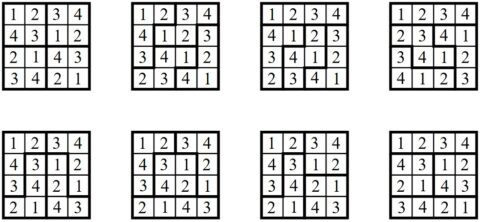
The 4 by 4 puzzles with subregions that are the 2 by 2 corners are exactly the same as the Shape Sudoku puzzles given before. You can go back to that page in these Resources to see solved versions of those puzzles. To create a numbered version of them, replace each colored shape by a number. For example, red circles could be 1, orange triangles 2, purple diamonds 3, and blue squares 4.
5 by 5 Puzzles
There are too many of these puzzles to come anywhere close to showing all the possible jigsaw geometries. These are here just to suggest what is possible. Your child may enjoy finding different ways of carving up a 5 by 5 square into pieces that have 5 small squares.
Pieces that consist of 5 little squares are called “pentominoes.” Making shapes with pentominoes can be lots of fun. Maybe cut out some pentomino shapes out of stiff thick colored paper and see what designs you can make!
6 by 6 Puzzles
Okay, you are getting the idea. There are a lot of these! Here are just a few 6 by 6 puzzles to give you some ideas for what is possible. As always, play around with your child with these puzzle pieces and numbers. Perhaps design a few of these together.

Helping your child
Puzzles are meant to be challenging and to take time, so please don’t ruin the fun by telling your child how to do them. These puzzles are chosen so that you can create them easily and then have fun solving them together.
If your child gets stuck on a puzzle, you have several options. You can, of course, give very small hints, if you can think of things that won’t give away the puzzle. You can suggest looking at smaller or simpler versions of the puzzle. Encourage your child to be bold in their ideas, even if sometimes they lead to dead ends. We all learn a lot from our mistakes and dead ends! Let your child know that it is perfectly okay not to solve a puzzle on the first (or second or third) try, and that useful ideas may occur to them if they leave the puzzle alone for a day or two.
These puzzles are meant to be fun and to teach problem solving. One of the greatest mathematical pleasures is that AHA moment, after many false starts and much wrestling with a problem, when the answer is finally discovered – be sure to let your child experience that feeling of discovery as many times as you can!