Sudoku – Comparing
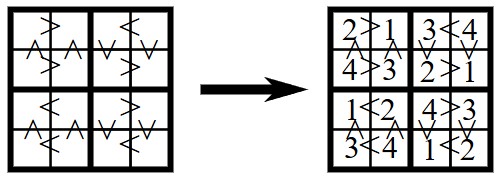
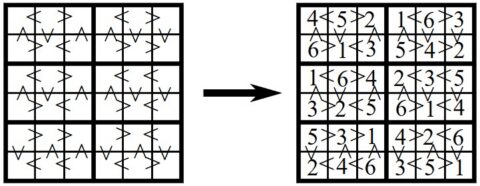
These puzzles start with the same rules as regular Sudoku – each number appears exactly once in each row, column, and subregion. Additionally, if there is a less than or greater than symbol between two cells, then the numbers in the cells must obey that relationship.
Hungry alligator
Tell a child who has never seen a comparison symbol, >, that the bigger number is on the side with the wider part of the symbol. Some people say that the symbol is a hungry alligator and it always wants its mouth to point in the direction of the larger number.
Solving strategy
First look for where the smallest and largest numbers are.
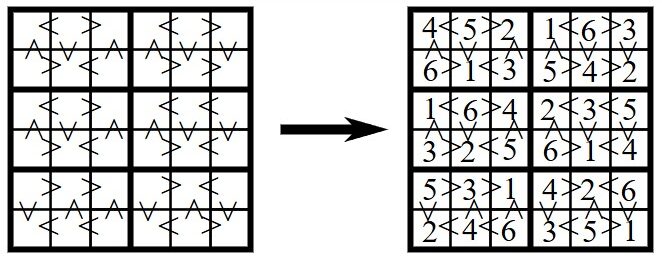
As your child gets better, make the puzzles more challenging by leaving out more of the inequality symbols.
Puzzle creation
Make these puzzles by using a finished Sudoku puzzle. Put in greater than and less than signs on a blank grid of the same geometry. If your child gets stuck, put in a few numbers to get them started.
Bonus Material
Introduction
Greater Than Sudoku puzzles start with the same rules as regular Sudoku – each number appears exactly once in each row, column, and subregion. Additionally, if there is a less than or greater than symbol between two cells, then the numbers in the cells must obey that relationship.
Make these puzzles by using a finished Sudoku puzzle – all the example Number Sudoku Jigsaw puzzles given early in these Resources will be useful in creating these puzzles. Put in greater than and less than signs on a blank grid of the same geometry. If you omit all the numbers and put in all the inequalities (less than or greater than), it is generally fairly easy to solve the puzzle. A useful strategy for your child is to first look for where the smallest and largest numbers should go.
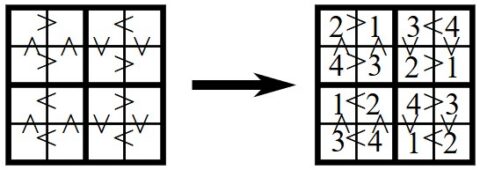
When your child is first learning how to do these puzzles, put in all the inequalities and some of the numbers. Gradually, start omitting more of the numbers and some of the inequalities.
Helping your child
Puzzles are meant to be challenging and to take time, so please don’t ruin the fun by telling your child how to do them. These puzzles are chosen so that you can create them easily and then have fun solving them together.
If your child gets stuck on a puzzle, you have several options. You can, of course, give very small hints, if you can think of things that won’t give away the puzzle. You can suggest looking at smaller or simpler versions of the puzzle. Encourage your child to be bold in their ideas, even if sometimes they lead to dead ends. We all learn a lot from our mistakes and dead ends! Let your child know that it is perfectly okay not to solve a puzzle on the first (or second or third) try, and that useful ideas may occur to them if they leave the puzzle alone for a day or two.
These puzzles are meant to be fun and to teach problem solving. One of the greatest mathematical pleasures is that AHA moment, after many false starts and much wrestling with a problem, when the answer is finally discovered – be sure to let your child experience that feeling of discovery as many times as you can!