Welcome to EFM's June Newsletter!
Read, Count, Play – Every Child, Every Day!
It is essential that every caregiver in the world reads books and does math with their young children!
EFM believes in every child’s mathematical right to equity, opportunity, and personal fulfillment.
News
Weekly Wonder – Starting on July 18, this project will deliver a free weekly email of “wonders” (puzzles and games) to teachers who sign up on the EFM website. These emails are to be copied and sent to the homes of a teacher’s families. We want to make it easy for teachers to share this side of math with their families. Another use is in support of a teacher’s Puzzle of the Week program in the classroom. There are three grade level bands for the material: K-2, 1-4, and 2-5. If you would like to get a sample of these before July 18, sign up to get a Sampler of 10 emails and see what this is all about.
Website – The new version of the EFM website continues to improve and grab worldwide attention. We are now averaging over 100 visitors a day and our visitors are coming from a greater variety of countries (due to our now having 100+ languages supported). In addition to being able to view each educator game and puzzle on its own page, we have added the ability to download the PDF for those activities individually.
Math Bingo – Just in time for summer, our website now has a Math Bingo card in English, Spanish, Arabic, Portuguese, and Russian. Challenge your child to make Bingo by looking for math throughout their world.
Projects under Development – We are always looking for projects that will help improve early mathematics, such as our Math Bingo card and the Weekly Wonder program. We are also working on a video project that will highlight over a dozen valuable qualities that a child will develop by engaging deeply with math. If you have an idea for a new EFM project, we would love to hear about it – please write to us.
Caregiver Tips
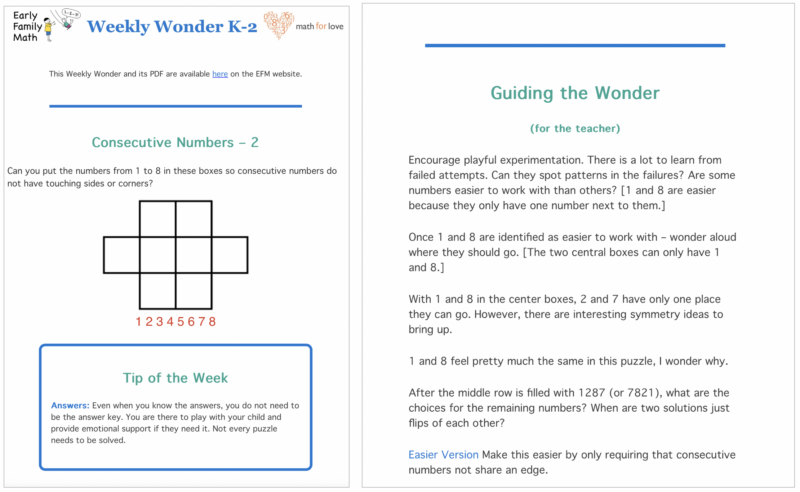
Each of the new Weekly Wonder emails includes a Tip of the Week (in the blue box) for the caregivers at home. Here is an example of an email (split in two so it will fit better).
Each Tip of the Week has a general idea not necessarily specific to the puzzle at hand. The tips we selected divide into four categories, though these categories overlap a great deal. The following 50+ tips are brief excerpts from our WW emails.
Tips: Problem-solving strategies
One of my favorite math topics is strategies for effectively tackling puzzles. A strategy such as “Learn from simpler or more extreme versions of a problem” is a life skill that gives access to insights in all aspects of life. Having families learn some of these strategies together is a wonderful opportunity.
Examples: Learn about a puzzle or game by doing lots of examples.
Stumped: Learn from related puzzles or games to get useful ideas.
Stumped: Put a puzzle down for a while and see what insights come after taking a break.
Guess and Check: Intelligent guess and check is a powerful method worthy of respect.
Organize the data: Make your information more understandable by putting it in an organized format.
Assumptions: Avoid wasting time on misunderstandings – look carefully at your understandings and assumptions.
Flexibility: Use midpoint targets in a puzzle, or perhaps work starting from the end.
Eliminate the impossible: Sometimes it is easier to eliminate the things that can’t happen.
Play: Just mess around with a puzzle sometimes and see what happens.
Approximations: Use approximations to check answers. See if your answers pass the “smell test” of reasonableness.
Diagram: Use annotated diagrams to understand and see what is happening in a puzzle.
Get physical: Understood some puzzles by using physical representations or by acting them out.
Simplify: Solve simpler versions of a puzzle as a step to solving the original puzzle.
Reflection: Review your finished work to consolidate understanding of what worked and what didn’t.
Tips: Attitudes
The attitudes of an Adult and child are at the heart of a successful program of doing math at home. While problem solving strategies may help with finding more solutions, developing good attitudes is even more important.
Play: Learning to play with math is more important than learning individual math skills.
Answers: Not every puzzle has to be solved. Avoid being your child’s answer key.
Answers: Resist telling the answers. Let them do most of the discovery, which is where the magic happens.
Everyone makes mistakes: Normalize mistake making by not hiding your mistakes.
Everyone makes mistakes: When your child makes a mistake, ask questions to help them discover it.
Playfully explore: Instead of pushing to make progress, enjoy playful exploration in a mathematical playground.
Explore: Pursue interesting questions that come up along the way. The most interesting journeys can be the ones you hadn’t planned to take.
Explore. Consider looking for many different ways to solve each puzzle.
Getting Stuck: Adults can get stuck too. Show your child it’s okay to be stuck – attempting to get unstuck can be the most interesting part.
Stumped: “I don’t know” is a perfectly good answer.
Quiet: When doing puzzles with your child, moments of quiet are good. You don’t need to fill them.
Listen: Your child’s idea may seem unusual or different, but that does not mean it is wrong. Listen to and respect their ideas and see where they lead.
Growth mindset: Never think a puzzle is beyond you and your child.
Frustration: This should be fun and without pressure to get the answer. Take a moment to calm down or walk away if either of you gets frustrated.
It’s contagious: Your excitement can become your child’s excitement.
Fearlessness: Make this time together a safe place where all ideas are welcome and none are made fun of.
Effort: Celebrate efforts more than you celebrate successes.
Negative mindsets: Tackle negative math mindsets and find ways to enjoy doing math together. Don’t let getting stumped or making mistakes get you down.
Feedback: Avoid fixing your child’s work. Ask lots of questions, such as “What was the reasoning behind this step?” to help them see their mistakes on their own.
Why: Have your child understand what they are doing rather than just following steps for how to do it.
Mathematicians: We can all enjoy being mathematicians together solving math puzzles and playing math games.
Questions: Encourage your child to voice their ideas. You should particularly encourage their questions.
Fun: Math can require effort and be challenging … and still be fun and fulfilling.
Partial solutions: Partial solutions can be a stepping stone to full solutions. Examining incorrect ideas can lead to insights.
Tips: Human Qualities
Engaging deeply with math has so much to offer in terms of helping someone develop as a person. EFM is working on a video series with this point of view. Here are some observations along those lines.
Listening: Model listening, a practice you want your child to have. It also shows them that you care about and respect their ideas.
Curiosity: Foster your child’s curiosity by following up on things they wonder about. Often the best part of a puzzle is the new things you wonder about.
Wonder: Encourage your child to ask questions about possibilities and explore interesting and surprising mathematical paths.
Perseverance: Recognize and praise your child’s effort and persistence.
Stuck: Encourage your child to see the places where they get stuck as the interesting and exciting parts.
Reasoning: Celebrate with your child when they reason their way through a math situation.
Confidence: Build confidence together as you do things you both never thought you could do.
Persistence: The most interesting math puzzles take more than 2 minutes to solve. Encourage and model persistence for your child.
New ideas: Doing mathematics often requires fresh ideas, insights, and creativity … and that is the fun part. Many puzzles use a method that you’ve never seen before.
Abstraction: Seeing how things are the same beneath the surface is a superpower.
Creativity: There is often more than one way to do a puzzle. There is also room for you to ask your own questions and explore interesting paths of your own creation.
Thinking Critically: Thinking carefully and deeply about someone else’s work, and discussing it thoughtfully and respectfully with them, is at the heart of critical thinking and cooperative teamwork.
Tips: Practices
These are some good general practices for doing math with your child.
Avoid Calculators: Save calculators for more advanced math. For now, develop number sense and fluency through having your child do the calculations.
Avoid Tricks: Mindless tricks, such as “add a 0 to multiply by 10,” are easy to learn, but blind your child to understanding what is going on.
Fluency: Math puzzles and games are more engaging and deeper ways to give fluency practice than using drill.
Questions: Ask open-ended questions that let your child explore and express their ideas.
Wrap Up
I hope I’ve given you some things to think about and tips to use in your own practice of mathematics. I also hope you will go over to the EFM website and explore our Weekly Wonder program. I’d love to hear from you if you have feedback about the program or want to get involved with it (or any other aspect of EFM).
If you have any questions or comments, please send them our way! We would enjoy the opportunity to chat with you. Also, if you are interested in collaborating with us or supporting us in any fashion, we would love to talk with you about ways we can work together!
June 18, 2026
Chris Wright
Chris@EarlyFamilyMath.org
Twitter | Facebook | Instagram
Early Family Math is a California 501(c)(3) nonprofit corporation, #87-4441486.