Welcome to EFM's April Newsletter!
Read, Count, Play – Every Child, Every Day!
It is essential that every caregiver in the world reads books and does math with their young children!
EFM believes in every child’s mathematical right to equity, opportunity, and personal fulfillment.
News
EFM Turns 5! –
It’s been five wonderful years for Early Family Math since the first website and newsletter. We have a great group of people supporting our program (please join us) and we have created a website, two mobile apps, and a very large collection of materials in over a dozen languages. To all our supporters, colleagues, and donors – Thank you! We could not have done it without you!
New Website – We are excited to announce that, in about a week, www.EarlyFamilyMath.org will point at a completely revamped EFM website. It has many new features for you to enjoy, and here are a few:
* 104 world languages supported through machine translation
* In addition to our traditional PDFs with human translations in a dozen languages, we now offer the ability to play with this material (such as our Puzzles or Games) directly on our website in 104 machine-translated languages.
* New characters and illustrations
Early School Math app – The Early School Math (ESM) mobile app now joins the Early Family Math (EFM) mobile app in both app stores.
ESM – Google Play Store
ESM – Apple
EFM – Google Play Store
EFM – Apple
Math and Political Representation
With all the controversies surrounding voting these days, it feels timely to talk about mathematical aspects of voting and how you might play with them with children.
Being limited to using whole numbers can lead to some tricky problems to solve. If a recipe calls for using 3 eggs, what do you do if you want to make a half batch and what happens with the leftover ingredients?
Political representations are a particularly tricky arena for this. Suppose the population statistics show that your state deserves to have 14 2/3 representatives in the House of Representatives. Using that exact answer is going to work out pretty uncomfortably for someone. It’s a shame there can’t be a single representative with 14 2/3 votes, but that’s not the way it works.
This newsletter looks at three aspects of political representation where the solutions are often surprisingly tricky and interesting.
Creating Voting Districts – Gerrymandering
While it is a topic with a long history, gerrymandering has been in the news a lot for at least the last year. Gerrymandering refers to constructing voting districts to gain an unfair advantage for one party or cause in an election. The big question is very hard to define: What does it mean to have an “unfair advantage?”
After a voting jurisdiction, such as a state, finds out how many representatives they have, they need to split up their geographic area into that many regions. There are a great many things that might be considered, and no clear way to give a fair voice to all the different considerations at the same time. It is so difficult that I won’t even try to get started on it here.
Instead, we will look at how things can be intentionally manipulated to be unfair. My friends at the Julia Robinson Mathematics Festival (JRMF) (https://jrmf.org/) have created some gerrymandering puzzles for children ( https://jrmf.org/puzzle/gerrymandering/ ). These puzzles are easily understood by a child, are good fun to play with, and provide simple illustrations of how the design of voting districts can be manipulated to help one side or the other.
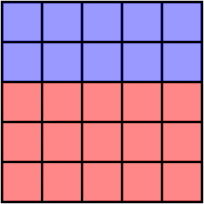
Pretend the grid above represents the geographic layout of voters in a district that needs to be split into five equal parts with five squares each (each little square represents a single voter). Further, suppose the blue squares are people interested in voting one way and the red squares are voting in the opposite way.
* What are some of the ways this can be split up to help one side or the other?
* Using different district designs, find the greatest and least number of districts red can control. Why must red dominate at least a few of the districts you create?
In all these JRMF gerrymandering puzzles there are two rules.
* The districts must be equal in size (have the same number of small squares).
* Each district is connected – it must be possible to travel between any two squares in a district by traveling along a series of squares in the district each pair of which share a side.
Using different jurisdiction sizes, shapes, and color totals, challenge each other to make voting districts where you can create surprising results. JRMF has many great examples.
If you want to get ambitious, create a jurisdiction with two things to balance at the same time. Now imagine what it’s like when you have maybe a dozen things to try to balance fairly, whatever “fairly” might mean.
Not only does this provide insights for your child in how gerrymandering works, it is also great practice for multiplying, dividing, and breaking a whole group into equal pieces.
House of Representatives
You might think it would be easy to allot the number of house representatives to each state for the US House of Representatives. Once you decide (somewhat arbitrarily) on the total number of representatives for the whole House (set at 435 since 1929), then you calculate what fraction of the entire population each state has and give them that fraction of the representatives. What could go wrong?
Suppose there are 100 representatives, four states (A, B, C, D), and the states deserved the following fractions of the total (1/5, 1/4, 3/10, and 1/4). In this case, A would get 20, B would get 25, C would get 30, and D would get 25. That’s pretty easy.
Ahhh, if only it were that simple. We come back to the problem of only being able to use whole number answers. You may be surprised to learn that this is tricky enough that there have been four different methods used since the first system created by Jefferson, which was used from 1790 to 1830.
Continue with the example of having 100 representatives for states A, B, C, and D. This time suppose they should get 1/3, 1/6, 2/7, and 3/14. If we could use fractional representatives they would have 33 1/3, 16 2/3, 28 4/7, and 21 3/7 representatives. The first step is to give the four states their basic whole numbers of representatives: A – 33, B – 16, C – 28, and D – 21 representatives. The big question that people spent 150 years arguing over is what to do with the remaining 2 representatives.
Before reading further, talk with your child about how you would tackle this problem.
The Hamilton method, which is the method most people come up with, says that you should give the leftover representatives to the states with the biggest fractions. Using Hamilton’s method, B would go from 16 to 17, and C would go from 28 to 29. Hamilton’s method was used from 1850 to 1890. People discovered the “Alabama Paradox” that occurred when the total number of seats in the House was increased, and soon after that discovery the Hamilton method was discarded.
A fairly simple example of things that can go wrong with the Hamilton method can be seen in these examples borrowed from Phillips Exeter Academy’s problem sets. For this, there are three states, A, B, and C. For each scenario, calculate the number of representatives each state would receive using the Hamilton method. When you are done, compare results and look for situations that seem odd or unfair.
Scenario 1: 100 total representatives. Populations of A 453; B 442; C 105 – total 1000
Scenario 2: 101 total representatives. Populations of A 453; B 442; C 105 – total 1000
Scenario 3: 100 total representatives. Populations of A 647; B 247; C 106 – total 1000
Scenario 4: 100 total representatives. Populations of A 650; B 255; C 105 – total 1010
Other early systems of apportioning seats in the house were created by Jefferson, Adams, and Webster. Jefferson’s was the one initially used in 1790. It seems like too much of a side journey for this newsletter, so I will leave it to more adventuresome readers to read about those and other systems that have been used.
Diophantine Equations
The ancient Greeks originally thought that all numbers could be expressed as fractions using whole numbers. That led them very naturally to only be interested in whole number answers to mathematical questions. At first blush you might think that this restrictive view would give them uninspiring math to work with. However, as we have seen, this restriction creates fun challenges to deal with. The ancient Greek Diophantus is so famous for looking at these questions that he has a whole section of mathematics named after him.
Some classical examples of Diophantine Equations are exploring the integer solutions of equations such as ax + by = c and a^2 + b^2 = c^2, and investigating when you can write an integer as the sum of two squares.
Voting Systems
If there are 99 people voting and two candidates, A and B, to vote for, the voting is pretty straightforward – whoever receives 50 or more votes wins. It gets trickier if there are an even number of people voting and there is a tie. Even for 99 people, philosophically there is a problem if 50 people barely prefer A to B, and 49 people think choosing A is unthinkably bad. Should A win? Instead of voting for A or B, should you be able to assign a fractional preference for each candidate?
It gets a lot trickier if there are three or more candidates. There are many ways to handle this situation and they can be fun to explore with children. Explore situations where the election does not come out the way you would like. Suppose there are 20 people voting for 4 candidates A, B, C, and D.
* Option 1: If no one gets a majority of the votes, the top two vote getters have a runoff election. Suppose that A and B each get 6 votes, and C and D each get 4 votes. There can be some unfortunate consequences if say all the people who voted for D would have voted for C if D hadn’t been running. This requirement can lead to paying for an expensive runoff election in which far fewer voters typically vote.
* Option 2: The candidate with the most votes wins. Suppose A gets 6 votes, B and C get 5 votes, and D gets 4 votes. Was A really such a popular choice? In 2024, a congressional candidate won a primary election in Arizona with a little under a quarter of the vote.
* Option 3: Ranked choice (also called Instant Runoff). This system is used in Alaska, Maine, and in a number of other jurisdictions. In this system, each voter ranks all the candidates in order of their preference. If one candidate has a majority of the first place votes, they are the winner. If not, the candidate with the fewest first place votes is removed (it’s as if they were never in the election), and all voters who chose that candidate for the first choice now are considered to have voted for their second choice. This process is continued as needed until a selection is made. The main drawback with this system is that it is more complicated for voters to understand and to make considered choices ranking all the candidates.
There is a danger with the first two options that third party candidates will not run because they can act as spoilers for one of the two main candidates. In the 2000 presidential election, it is widely thought that Ralph Nader running as a third party candidate changed the outcome of the election – of course, looking at alternative universes and analyzing “what ifs” can be tricky.
Wrap Up
I hope you enjoy looking at some of these voting topics with your child. I realize that these examples cover a range of math skills – I hope your child will enjoy exploring the ones that work well for them.
Here’s to another five years of improving early math education! It’s been a very fulfilling ride for me!
If you have any questions or comments, please send them our way! We would enjoy the opportunity to chat with you. Also, if you are interested in collaborating with us or supporting us in any fashion, we would love to talk with you about ways we can work together!
April 18, 2026
Chris Wright
Chris@EarlyFamilyMath.org
Twitter | Facebook | Instagram
Early Family Math is a California 501(c)(3) nonprofit corporation, #87-4441486.