Bouncing Billiard Ball
THE CHALLENGE
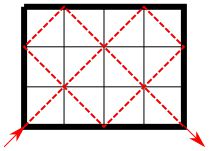
A billiard ball shot at a 45 degree angle from the lower left corner of a 3 by 4 billiard table will bounce 5 times before hitting the lower right corner of the table. If you start at the lower left corner of a 4 by 7 billiard table, how many times will the ball bounce before hitting one of the corners?
EXPLORATION
For other sizes of tables, can you predict which corner will be hit first and how many bounces will be made? Can you use some ideas from geometry to help you simplify the problem?
Notes
THE CHALLENGE & EXPLORATION
This can be played with and thoroughly enjoyed by using a piece of graph paper and seeing what happens. It can also be approached more systematically and rigorously.
The first thing to notice is that the size of the table is not as important as its shape. Any rectangle that is similar to another (has the same ratio of side lengths) will give the same result. So a 3 by 4 table will be the same as a 6 by 8 table and a 9 by 12 table.
A useful exercise at this point is to collect the results of what happens for 1 by n and 2 by n tables.
- 1 by n: The ball will take n – 1 bounces and will end up in the bottom right corner for n even, and top right corner if n is odd.
- 2 by n: If n = 2k, then 2 by 2k behave like a 1 by k table (because they are similar). A 2 by (2k + 1) there are n bounces and the ball ends up in the upper left corner.
After some more experimentation a general result appears!
Result
If k and n have no factors in common, then a k by n table will have k + n – 2 bounces. The ball will end in the upper left corner if k is even. If k is odd, the ball will end in the upper right corner if n is odd and in the lower right hand corner if n is even. If k and n do have common factors, then divide out those factors and apply this result to the reduced numbers.
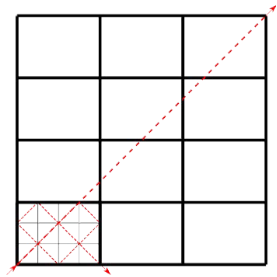
One neat technique to see this more easily is to “unfold” the bounces. Make a grid of tables, as pictured, and let the ball go in a straight line through all the table tops!