
Water Cups – 2
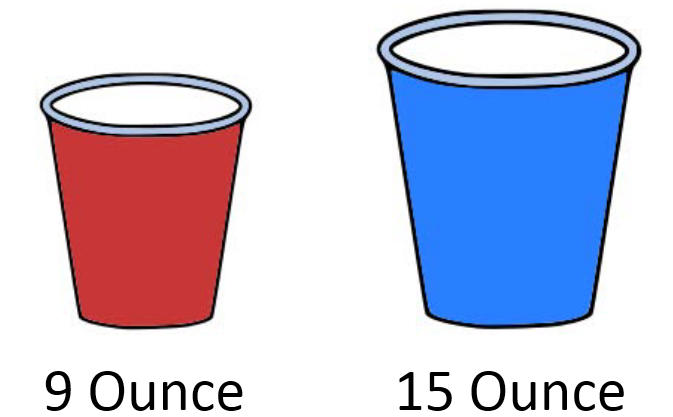
You have two unmarked water cups. One holds 9 ounces and the other 15 ounces. You also have a large supply of water. You can use these two cups to create amounts other than 9 ounces and 15 ounces. For example, create 6 ounces in the larger cup by filling the 15-ounce cup and then pouring 9 of its ounces into the smaller cup.
THE CHALLENGE
Find all the amounts that you can create using these two cups.
EXPLORATION
Investigate other pairs of water cups that involve two numbers with a common divisor greater than 1. What patterns do you notice?
Notes
THE CHALLENGE & EXPLORATION
The two numbers, 9 and 15, have a greatest common divisor of 3.
Whatever the greatest common divisor is, you will only be able to produce answers that are a multiple of their greatest common divisor.
The easiest way to work with this problem is to imagine creating a new unit. In this case, let’s call that unit ThreeOunce, and it will equal 3 ounces. So we have one cup that holds 3 ThreeOunces and the other holds 5 ThreeOunces. Now, the analysis proceeds exactly as it did in “Water Cups – 1” with a 3-unit and a 5-unit cup.
Fill the 5-unit cup.
Pour 3 units from the larger cup into the smaller cup, leaving 2 units in the larger cup.
Empty the smaller cup, pour the 2 units into the smaller cup from the larger cup, refill the larger cup, and fill the smaller cup. That leaves 4 units in the larger cup.
Empty the smaller cup and pour 3 units from the larger cup into the smaller cup. That leaves 1 unit in the larger cup.
So, we have a method that produces 1 through 5 units, as expected.
This translates into being able to produce 3 ounces, 6 ounces, 9 ounces, 12 ounces, and 15 ounces.
In general, we will be able to produce every multiple of the greatest common divisor up to the size of the bigger cup.