
Card Deck Ordering -1
Two Steps
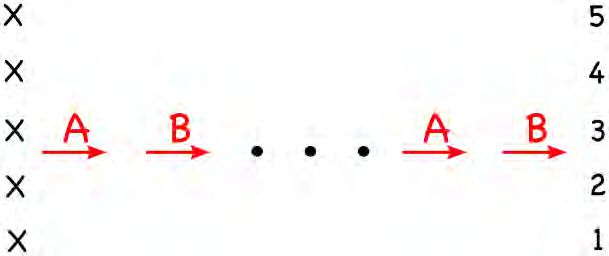
Step A: Remove the top card from the stack of cards and place it on top of the discard pile.
Step B: Move the new top card of the stack to the bottom of the stack.
Example
if you start with a stack of cards ordered 1- 3- 2 and then repeatedly use the Two Step process, the result is a discard pile of cards ordered from largest to smallest: 3- 2- 1.

The Challenge
Take cards numbered 1 to 5 and stack them in some way so that if you repeat the Two Steps over and over with that stack, you will end up with a discard pile of cards in order from 5 down to 1.
Exploration
Can you do this for decks with cards from 1 to 6, 1 to 7, or even higher? What patterns do you notice?
Notes
The Challenge & Exploration
The difficulty with this puzzle is being systematic. For any size deck of cards, you can play around with it and eventually come up with the answer, and that is perfectly fine for a young child.
Let’s look for interesting patterns that make it easier.
Suppose you lay out the cards in order on the table. Here are the solutions for the first seven cases. Let’s see what we can learn from them. The numbers listed after the arrow give the order of the remaining cards after the first pass through the cards – that is, after each card has been touched just once.
1
1 2 -> 2
1 3 2 -> 3
1 3 2 4 -> 3 4
1 5 2 4 3 -> 5 4
1 4 2 6 3 5 -> 4 6 5
1 6 2 5 3 7 4 -> 6 5 7
If there are an even number of cards (say 6), then the odd positions are filled with the first half of the cards in order (3 in this case), and the other spots are filled using the solution for half as many cards only bumped up in value. In the example for 6, the odd spots are filled with 1, 2, 3, and the even spots are filled with 4, 6, 5 – the values 1, 3, 2 (the solution for a three-card deck) each increased by 3.
The pattern for an odd number of cards is a little trickier. As before, the odd spots are filled with the first roughly half of the numbers (1 to 4 in the case of 7). If you look at the examples, the first card after the arrow is going to be moved to the end, so it should be the card you want last in that sequence. After that observation, the answer proceeds as in the even case.