
Coin Flipping – 1
A coin may be placed heads up or down in any empty spot. When a coin is placed, all coins touching its sides must be flipped over.
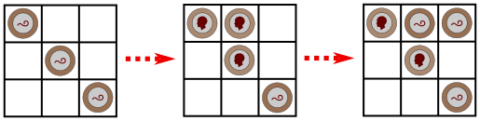
THE CHALLENGE
Fill this grid so all the coins end up heads up or heads down.
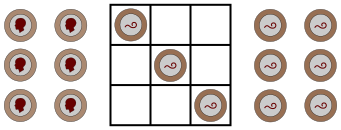
EXPLORATION
Put a few coins in other starting positions and see which of these work out. Can you find any patterns in which ones work and which ones don’t?
Notes
THE CHALLENGE
This puzzle can be solved enjoyably and satisfactorily with a lot of trial and error. To reduce the trial and error, predict the number of flips an existing coin will have. For example, the coins in the upper left and lower right corners have two neighbors, so they will each be flipped twice (ultimately leaving them the same as they started). Similarly, the coin in the center has four neighbors, so it will be flipped four times and return to its original state. So, no matter the choices that are made, the three diagonal coins will all end up being heads down.
Once you know how to handle the diagonal coins, the rest of this small puzzle is pretty straightforward.
EXPLORATION
For any puzzle with three coins in a single row, column, or diagonal, to be doable the coins must all be heads up or heads down. For other arrangements, it will be determined by whether the initial number of empty slots around each coin is odd or even.