
Fill in the Blanks – 4
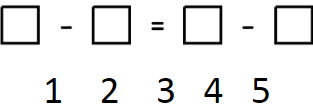
Using the numbers from 1 to 5 at most once, this equation has three solutions.
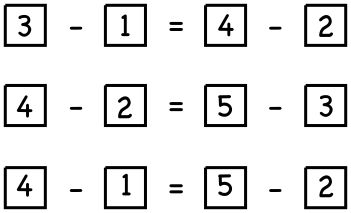
The three solutions are:
THE CHALLENGE
Use each of the numbers from 1 to 8 at most once to fill in these blanks.

EXPLORATION
Explore other number ranges. What happens if you use 1 to 9, 0 to 7, or 0 to 8?
Notes
THE CHALLENGE
As with the other Fill in the Blanks puzzles, a child can just play with this and eventually arrive at the answers. That exploration involves a lot of good experiences, and there is no reason to avoid it.
To be more systematic, use that you have three pairs of numbers that have the same sum. To make that triple sum as small as possible, we could attempt to use the numbers 1 through 6 for them. The sum of the numbers 1 through 6 is 21, and if you break that into three equal parts, that would be a sum of 7 for each individual sum.
Let’s look at the two possibilities – the sum is either 7 or 8. For each number, there are only three possible ways to produce that as a sum, and we quickly find the two solutions.
7 = 1 + 6 = 2 + 5 = 3 + 4
8 = 1 + 7 = 2 + 6 = 3 + 5
EXPLORATION
Let’s explore the three suggested ranges to look at.
The range 1 to 9: The only new possibilities introduced by using 1 to 9 is having 9 as the sum. That creates
9 = 1 + 8 = 2 + 7 = 3 + 6 = 4 + 5
We can select any three of those four ways to add up to 9.
The range 0 to 7: You can think of 0 to 7 as subtracting 1 from each member of the range 1 to 8. Subtracting 1 from both members of a sum will reduce the sum by 2. The sum can now be one of 5, 6, or 7.
5 = 1 + 4 = 2 + 3 – there aren’t enough ways
6 = 1 + 5 = 2 + 4 – there aren’t enough ways
7 = 1 + 6 = 2 + 5 = 3 + 4 – the same as before.
It turns out that the 0 doesn’t help. To use 0 in a sum would force the digit to be used both in the sum and as the total, which isn’t allowed.
The range 0 to 8: As we just found out for the range 0 to 7, the 0 isn’t going to help. The only solution we find here is the same one we got before: 8 = 1 + 7 = 2 + 6 = 3 + 5.