
Fill in the Blanks – 5
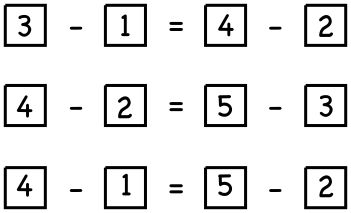
Using the numbers from 1 to 5 at most once, this equation has three solutions.
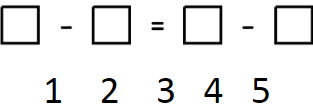
The three solutions are:
THE CHALLENGE
Use each of the numbers from 0 to 9 at exactly once to fill in these blanks.

EXPLORATION
Can you solve similar puzzles that break up a number range into common sums? How about four pairs using the numbers 0 to 7 or 1 to 8? How about 3 triplets from 0 to 8 or 1 to 9? How about 2 groups of
5 for the numbers from 0 to 9? Do you see any patterns for when it works and when it doesn’t?
Notes
THE CHALLENGE
As with the other Fill in the Blanks puzzles, a child can just play with this and eventually arrive at the answers. That exploration involves a lot of good experiences, and there is no reason to avoid it.
If you want to be more systematic, the first question is: What is the common sum for these pairs of numbers? The five pairs have the same sum, and when we add them all up we get the same thing as adding the numbers up from 0 to 9. The sum from 0 to 9 is 45, so when we divide that by 5 we get 9 – the sum for each pair must be 9. Once that is established, the rest is simple:
0 + 9 = 1 + 8 = 2 + 7 = 3 + 6 = 4 + 5.
EXPLORATION
The first step is to see whether the sum of the range of numbers can be broken into that many equal pieces. Also, note that it makes no difference whether we start at 0 or 1, so we’ll just look at starting at 0.
0 to 7 using 4 pairs: The sum of the numbers from 0 to 7 is 28. Dividing 28 into 4 pairs gives a sum of 7 for each pair. This is simple enough: 7 = 0 + 7 = 1 + 6 = 2 + 5 = 3 + 4.
0 to 2n – 1 using n pairs: After looking at 0 to 7 and 0 to 9, the pattern is clear: write n as the n possible sums.
0 to 8 using 3 triplets: The sum from 0 to 8 is 36. Dividing 36 into 3 triplets gives a sum of 12 for each triplet. The triplets will be largely driven by the three largest numbers (6, 7, 8), no two of which can be in a triplet together. This produces triplets (8, 0, 4), (7, 2, 3), and (6, 1, 5). This could also be done as (8, 1, 3), (7, 0, 5), and (6, 2, 4).
0 to 9 using 2 groups of 5: The sum from 0 to 9 is 45. 45 cannot be divided evenly into two equal groups!
The very interested child may want to go exploring further to see more examples of when this works and when it doesn’t. What fun!