
Fill in the Blanks – 7
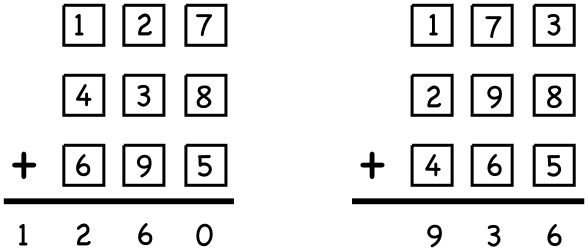
These sums, using the numbers from 1 to 9 once each, are not particularly close to 1000.
THE CHALLENGE
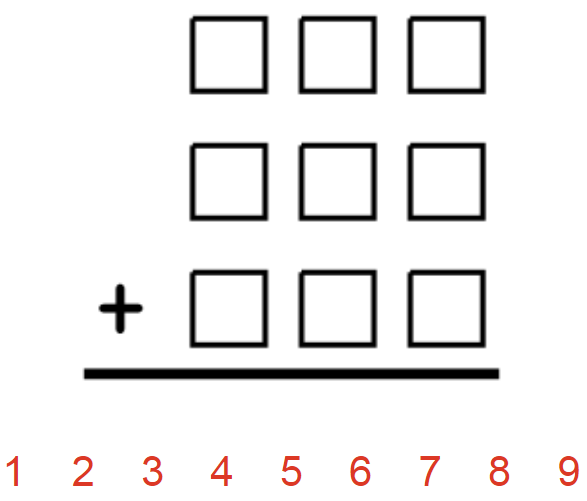
Use the numbers from 1 to 9 once each to make a sum as close to 1000 as possible.
Notes
THE CHALLENGE
A useful thing to notice is that it does not matter how we pair up the numbers in the ones column, the tens column, and the hundreds column, so that is one less thing to think about.
Note that the sum of all the digits from 1 to 9 is 45. From a bit of number theory (think “casting out 9’s”), because the sum of the digits is a multiple of 9, the resulting sum of all three three-digit numbers must be a multiple of 9. Therefore, the closest number we can hope for is 999, with 1008, and 990 coming in close behind that.
To get close to 1000, we want the hundreds column to add up to 8 or 9. So, we consider those two cases.
Case 1: The hundreds column sums to 8 (either as 1 + 2 + 5 or 1 + 3 + 4). In this case, we want the sum of the three two-digit numbers in the tens and ones column to be as close to 200 as possible. In that case, we want the sum of the tens digits to be 18, 19, or 20 – the corresponding sums of the ones digits will be 45 – (8 + 18) = 19, 45 – (8 + 19) = 18, and 45 – (8 + 20) = 17. The overall sums corresponding to these three scenarios are then 999, 1008, and 1017.
We can’t do any better than 999. We want the hundreds digits to sum to 8, the tens digits to sum to 18, and the ones digits to sum to 19. Here are some sample answers: 152 + 368 + 479 = 999 and 194 + 237 + 568 = 999.
Case 2: The hundreds column sums to 9. In this case, we want the sum of the three two-digit numbers in the tens and ones column to be as close to 100 as possible. However, given that the hundreds digits add up to 9, the smallest three more numbers for the tens column can add up to is 21 – 9 = 12 (the 21 comes from the sum of the numbers from 1 to 6). So, this is hopeless.