
Water Cups – 1
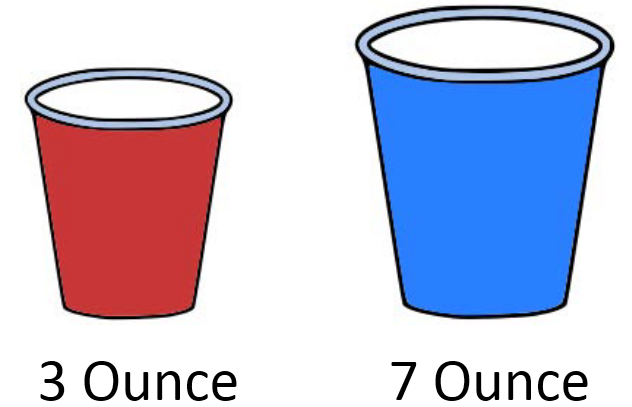
You have two unmarked water cups. One holds 3 ounces and the other 7 ounces. You also have a large supply of water. You can use these two cups to create amounts other than 3 ounces and 7 ounces. For example, create 4 ounces in the larger cup by filling the 7-ounce cup and then pouring 3 of its ounces into the smaller cup.
THE CHALLENGE
Describe the steps for putting 2 ounces in one of these cups.
EXPLORATION
Describe the steps to take to create any amount from 1 to 7 ounces. What is your general method? Experiment with what happens if your pair of cups have different sizes. For example, what happens if the sizes in ounces are 4 and 7, or 5 and 11?
Notes
THE CHALLENGE:
There is a temptation with this puzzle to do a lot of disorganized experimenting that happens upon solutions accidentally. That is good fun and should not be discouraged. However, by simply refilling the larger cup, multiple times if need be, it is straightforward to achieve each amount.
Fill the 7-ounce cup. That achieves a 7-ounce amount.
Next, pour out 3 ounces into the smaller cup. There are now 4 ounces in the larger cup and 3 ounces in the smaller.
Empty the 3-ounce cup and refill it from the larger cup. There is now 1 ounce in the larger cup.
Empty the 3-ounce cup, pour 1 ounce from the larger cup into the smaller one, refill the larger cup, and fill the 3-ounce cup from the larger one. There are now 5 ounces in the larger cup.
Empty the 3-ounce cup and refill it from the larger cup. There are now 2 ounces in the larger cup.
Empty the 3-ounce cup, pour 2 ounces from the larger cup into the smaller one, refill the larger cup, and fill the 3-ounce cup from the larger one. There are now 6 ounces in the larger cup.
Every amount has now occurred somewhere along the way. If you want all the amounts to occur in the larger cup, you can add one final additional step to this process (that is the same as all the others) to leave 3 ounces in the larger cup.
EXPLORATION
This simple process will always work as long as the two amounts are relatively prime, that is, they have no common factor larger than 1. So, if the amounts are 4 and 7, or 5 and 11, then all the amounts up to the size of the larger cup are easily obtainable.