Welcome to EFM's October Newsletter!
Read, Count, Play – Every Child, Every Day!
It is essential that every caregiver in the world reads books and does math with their young children!
EFM believes in every child’s mathematical right to equity, opportunity, and personal fulfillment.
News
Weekly Wonder – Consider joining over 2100 educators and sign up for our free weekly emails.
“As a mathematics teacher educator, I work regularly with kids from First Grade all the way up to University students, and I have been enjoying the Weekly Wonder puzzles each week. I signed up for all of them! While a puzzle might be labeled K-2, I have found them to be fun for people of all ages … they’re just accessible enough for a Kindergartener to try. There are wonderful connections among the different grade levels, and themes that develop from week to week. A learner who enjoys one might be able to pose extensions themselves. Give them a try – for your learners or yourself!” – John Golden, Professor of Mathematics at GVSU.
Rep-tiles
There are many playful ways for children to look at filling shapes with smaller shapes. Typically these shapes are polygons, though they need not be.
Younger children can use pattern blocks to make patterns and free form shapes. They can even work on technical challenges of finding how many ways of they can fill a large triangle or hexagon with pattern blocks. Similar things can be done with Tangrams or Pentominoes. Tiling flat surfaces with one or more types of shapes (called tessellations) is another direction to go in. I wrote about some of these topics in our December, 2024, newsletter.
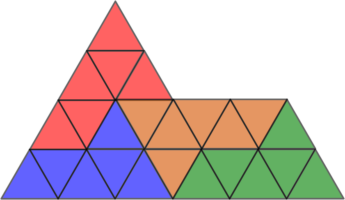
In this newsletter I want to explore what happens when filling a shape with smaller versions of itself. When it’s possible to do this at all, the shape is called a “rep-tile” – I’ll admit that mathematicians have an odd sense of humor. The “Sphinx” rep-tile is pictured above with four copies of itself filling it in.
For a rep-tile, Regular tilings are ones where all the shapes are the same size, Irregular tilings are ones that are not regular, and Perfect tilings are irregular tilings where no two of the shapes are the same size.
We will only look at child-appropriate examples, where the sizes of the pieces are whole number multiples of each other.
Enough with all the definitions and descriptions, let’s look at some examples.
Squares, Rectangles, and Regular Triangles
There are many fun questions to be asked about filling rep-tiles. Many of these are already EFM Puzzles of the Week. We will also stretch things a bit by looking at filling a square with rectangles, or a rectangle with squares.
Topic 1: If you fill a square with squares, how many squares are possible? What happens for regular, irregular, and perfect tilings?
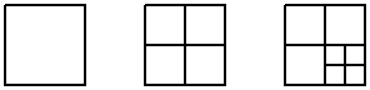
The question of how many squares can occur in irregular tilings is the EFM puzzle “Filling Squares with Squares.” While understandable by a fairly young child, it requires patience and persistence of a slightly older child to tackle the puzzle, or at least a child working with an adult. Perfect tilings are very hard to find. I’ll leave it to you to investigate all the regular tilings of a square.
Topic 2: If you fill a regular triangle with such triangles, how many triangles are possible? What happens for regular, irregular, and perfect tilings?
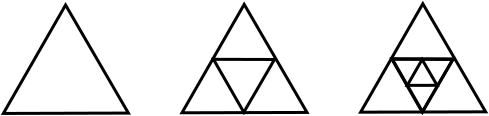
Somewhat surprisingly, this is very similar to what happens for squares in Topic 1. The question of how many regular triangles can occur is the EFM puzzle “Filling Triangles with Triangles.”
Topic 3: Can you determine the sizes of the squares when you are given a drawing of a rectangle filled with squares?
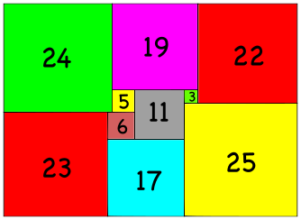
Discovering ways to fill in a square or rectangle with squares of different sizes (perfect tilings) can be very tricky (for anyone). Here are a couple great resources on this subject. The Wikipedia article on “Squaring the Square” has a wonderful collection of illustrations, descriptions and references for breaking apart squares in many ways. For a completely over the top collection of these, consult “Squaring.net” to see more ideas on this subject than you ever thought possible.
However, figuring out the sizes of the squares using an existing drawing is not nearly as difficult and can be a fun puzzle. For two examples of these puzzles, check out the EFM Puzzles of the Week “Perfect Rectangles – 1” and “Perfect Rectangles – 2.”
Topic 4: Can you fill a square with rectangles in such a way as to minimize the difference in the areas of the largest rectangle and the smallest rectangle? This is the Mondrian Art Puzzle created by Gordon Hamilton.
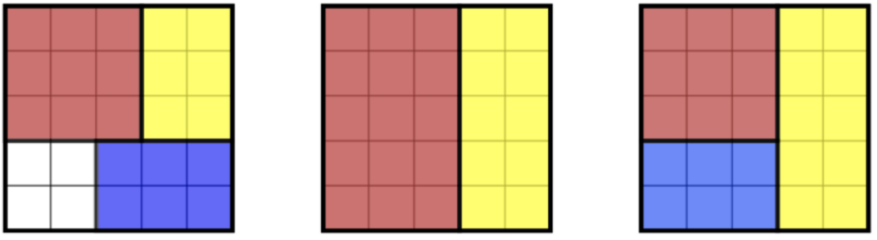
This question is the EFM puzzle “Filling Squares with Different Boxes.” One fun aspect of this puzzle is that you can always come back to it to see if you can improve upon your earlier work, and there is lots of room to discuss ideas with others.
More Rep-tiles
Now it is time to play with some more exotic rep-tiles. There are far too many rep-tile shapes for me to touch on even a representative sample. What follows are a few of the easier examples for a child to work with. To look at a larger catalog, consult the Wikipedia page on “Rep-Tile” shapes. Rep-tiles are a relatively new topic for me, so the following questions have not been incorporated into the EFM Puzzles of the Week collection.
Topic 5: If you fill a 3-square L shape with smaller L shapes, how many L shapes are possible?
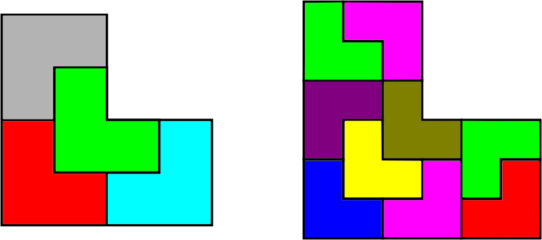
Counting the possible 3-square L shapes is a little trickier than for the squares and triangles in Topics 1 and 2. Let your child play with this before showing them the diagrams above.
From these pictures, we know that 1, 4, and 9 are all possible. Using the 4 version, we can replace any single L shape with 4 of them – this tells us that any number of the form 1 + 3n is possible. Similarly, using the 9 diagram tells us that anything of the form 1 + 8m is possible. Combining the two ideas tells us that anything of the form 1 + 3n + 8m is possible. Ask your child what the earliest number is when there are no more gaps in the tiling counts – this is known affectionately as the Chicken McNugget problem.
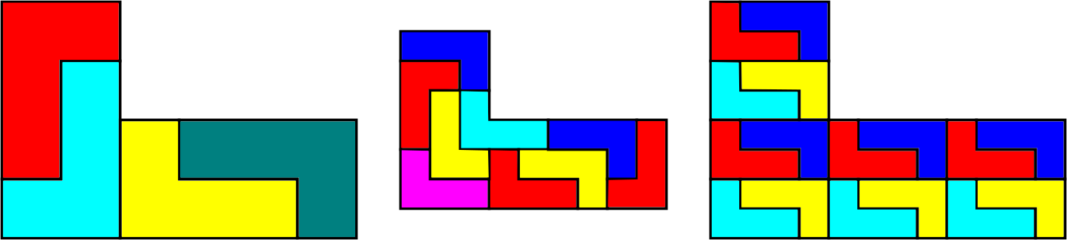
Topic 6: If you fill a 4-square L shape with smaller L shapes, how many L shapes are possible? Here are three examples.
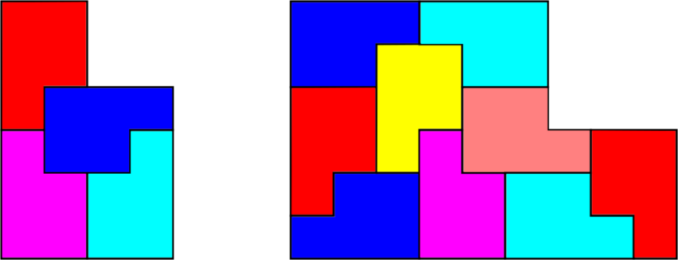
Topic 7: If you fill a 5-square Utah shape (a 2 by 2 square with a 1 by 1 square on top) with smaller Utah shapes, how many Utah shapes are possible?
Topic 8: All triangles are rep-tiles. One way to see this is to connect the midpoints of any triangle to divide it into four smaller copies of itself.
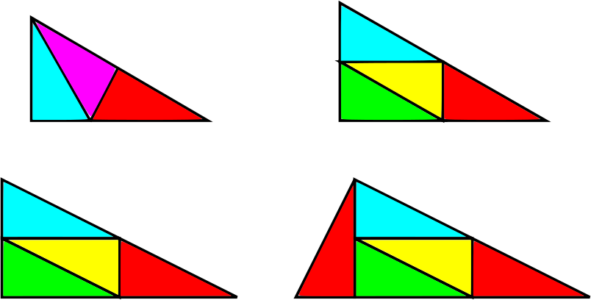
Here are two examples of rep-tiles that are right triangles with two sides that are whole numbers. The triangles in the first row have sides 1 – sqrt(3) – 2, and the triangles in the second row have sides 1 – 2 – sqrt(5). There are other right triangles that create interesting tilings, but in general, this is too technical for an elementary school student.
Wrap Up
I hope you have enjoyed playing with these rep-tiles and that you will explore other possibilities that rep-tiles offer. Some of my upcoming newsletters will look at how to create playful shapes by folding, cutting, or weaving pieces of paper in various ways. I am looking forward to taking a deep dive into some of that material and exploring it together!
If you have any questions or comments, please send them our way! We would enjoy the opportunity to chat with you. Also, if you are interested in collaborating with us or supporting us in any fashion, we would love to talk with you about ways we can work together!
October 18, 2026
Chris Wright
Chris@EarlyFamilyMath.org
Twitter | Facebook | Instagram
Early Family Math is a California 501(c)(3) nonprofit corporation, #87-4441486.